
Menstuff® has compiled the following information on "EMO".
Related Issues:
Self Injury, Self
Mutilation


EMO
How to Be Emo
Parents warned over the new EMO goth
danger
The Difference between Emo And Goth
Dress
Grammar
History - Opinions Differ
The Music
Self-Injury
Go from
Emo to Goth
Be
Emo when You Hate Rock Music
Be
a Goth, Punk and Emo at the Same Time
Turn
Emo Without Anyone Noticing
Dress
Emo for a Hot Summers Day
Be
Emo in Middle School
Get Emo
Hair
Appreciate
Emo Music
Look
Emo
Example
of emo music
Emo
- Setting its definition straight
30
emo bands that prove emo isn't dead.
An
article about band's mislabeled as emo from MTV.
Emo
musicians share thought on the term "emo".
As the style was echoed by contemporary American punk rock bands, its sound and meaning shifted and changed, blending with pop punk and indie rock and encapsulated in the early 1990s by groups such as Jawbreaker and Sunny Day Real Estate. By the mid-1990s numerous emo acts emerged from the Midwestern and Central United States, and several independent record labels began to specialize in the style.
Emo broke into mainstream culture in the early 2000s with the platinum-selling success of Jimmy Eat World and Dashboard Confessional and the emergence of the subgenre "screamo". In recent years the term "emo" has been applied by critics and journalists to a variety of artists, including multiplatinum acts and groups with disparate styles and sounds.
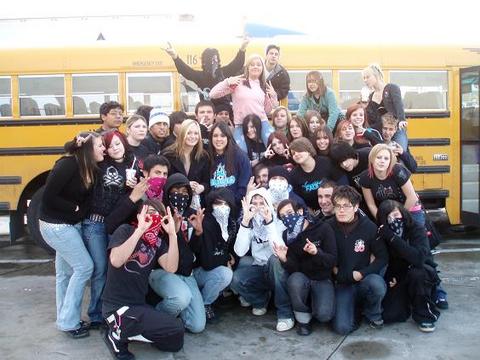
In addition to music, "emo" is often used more generally to signify a particular relationship between fans and artists, and to describe related aspects of fashion, culture, and behavior.
Stereotypes
Emo has been associated with a stereotype that includes being particularly emotional, sensitive, shy, introverted, or angst-ridden.[156][157][158] It has also been associated with stereotypes like depression, self-injury, and suicide.[159][160] Emo has also been constantly confused before with Goth.
Gender bias
Emo has been criticized for its androcentrism.[161] Andy Greenwald notes that there are very few women in emo bands, and that even those few do not typically have an active voice in the songs' subject matter: "Though emo—and to a certain degree, punk—has always been a typically male province, the monotony of the labels' gender perspective can be overwhelming."[162] The triumph of the "lonely boy's aesthetic" in emo, coupled with the style's popularity, has led to a litany of one-sided songs in which males vent their fury at the women who have wronged them:[162] Some emo bands' lyrics disguise violent anti-women sentiments in a veneer of pop music.[163]
However, despite emo's frequent portrayal of women as powerless victims, fans of the style are from both genders, and some acts have even greater popularity with women than with men.[164] One explanation for this is that the unifying appeal of emo, its expression of emotional devastation, can be appreciated equally by both sexes regardless of the songs' specific subjects.[165]
Suicide
Emo music has been blamed for the suicide by hanging of teenager
Hannah Bond by both the coroner at the inquest into her death and her
mother, Heather Bond, after it was claimed that emo music glamorized
suicide and her apparent obsession with My Chemical Romance was said
to be linked to her suicide. The inquest heard that she was part of
an Internet "emo cult" [177] and her Bebo page contained an
image of an "emo girl" with bloody wrists.[178] It also heard
that she had discussed the "glamour" of hanging online[177]
and had explained to her parents that her self-harming was an "emo
initiation ceremony".[178] Heather Bond criticised emo
fashion, saying: "There are 'emo' websites that show pink teddies
hanging themselves." After the verdict was reported in NME, fans of
emo music contacted the magazine to defend against accusations that
it promotes self-harm and suicide.[179]
Source: en.wikipedia.org/wiki/Emo
The Emo Lifestyle
Emo is a state of mind. But like "hipster," "punk," and
"leftist," it can mean any number of different things. Mostly, you'll
just need the right attitude. Being emo is all about emotional
reflection, an acknowledgment of personal anxiety, and a passion for
expressive music.
Although others might consider it an easy way to call someone emotional, they aren't strictly correct. Every human is emotional, though compared to an emo every other human might as well be a Vulcan. People who are emo are simply prepared and comfortable enough to showing their natural human emotions.
Understand what emo is. The meaning of emo comes from music — "emo" is short for emotive hardcore, a sub-genre of post-hardcore, which still has roots in indie rock, alternative or pop punk today. So its ties to music are especially strong, and they provide the basis for our common understanding of what it means to be emo. But someone who is emo have number of different ways of relating to one another and standing out. Emo is a lot of things. The music was underground in the 1980s and 1990s. Although, Jawbreaker did have a little bit of fame as they released their classic emo album "Dear You" and were on a major label. It then got big by the early 2000s with Jimmy Eat World's albums Clarity and Bleed American and even with bands like Dashboard Confessional and The Get-Up Kids.
So while the guy with dark hair and guyliner listening to Dashboard Confessional in Portland might be considered emo by a lot of people, the California blonde who surfs and listens to Dashboard Confessional might consider herself emo as well. There's no one judge about who's emo and who isn't.
People who are emo identify themselves through fashion, but not always. Emos have a way of dressing and expressing themselves through clothes. Some people believe that emo is a way of life and others believe it is a teenage grow out fad. Some people believe there are rules to being emo things such as never calling yourself "emo" and listening to the right bands. Others think that all you need is the right emotional outlook.
Music
Appreciate Emo music. It's an essential thing in emo! Emo started
in Washington DC with bands like Rites of Spring, The Hated and
Embrace during the middle of the 1980s. Originally short for
emotional hardcore, these bands were influenced by punk rock. In the
early 1990s, when the emotional hardcore bands faded. Emo was
reinvented for a more indie/alternative/pop punk style with bands
like Sunny Day Real Estate, Jimmy Eat World, Weezer and Dashboard
Confessional. Bands like Jawbreaker, however, had a punk-influenced
style. Today, bands can have punk influences (My Chemical Romance
[early], The Used, Senses Fail), alternative/indie influences
(Brand New), or pop punk influences (Paramore, Fall Out Boy).
Probably the first and most important thing to do in order to be considered emo is to listen to emo bands. Test yourself. Try listening to emo music and see if you end up liking it. If you finish wanting to download or buy the songs after you’re done with the album, you’re probably a true emo. If you don't like the music, that's okay too. You can still express your emotions through fashion and lifestyle. You can try many styles of emo like old emo, emotional hardcore, indie-emo, emo-pop, screamo, new emo, emoviolence, etc.
If you don't like normal emo, try listening to screamo. Screamo is closely related to emo but with more hardcore punk influence and screaming. Some screamo bands include: I Would Set Myself On Fire For You, Portraits of Past, Orchid (not to be confused with the metal band), Pg.99, Alexisonfire, I Hate Myself, the Saddest Landscape, Indian Summer, Break the Silence, Neil Perry, Alexisonfire, Heroin, Underoath (2002), The Used (not very often though), From Autumn to Ashes, Circle Takes The Sqaure, Funeral Diner, City of a Caterpillar, Anomie and Piano Become The Teeth. If you end up liking the music, it doesn't really matter what you call it.
You could also try emoviolence, which is screamo that has a ton more hardcore punk influences in it and even some influneces from powerviolence. Try bands like Orchid, Reversal of Man and United Nations.
Consider picking up an instrument. Being able to play music by yourself or in a band would give you huge credibility. Remember, though, that it takes quite a while for most people to learn an instrument and to start being able to play songs.
You can try emo-pop, too. Emo-pop is emo with a pop punk style. Pioneered by bands like The Get-Up Kids, Midtown, The Starting Line, The Movielife and Jimmy Eat World, other bands include Paramore and Fall Out Boy. Pop punk, in case you didn't know is loud, punk-influenced pop rock. Pop punk bands (not saying these are emo) can include Sum 41, New Found Glory and Good Charlotte.
Try playing the bass or guitar, or perhaps even the violin, which sounds amazing in emo songs if you invest enough time in it. The drums might also be a very good instrument. You can even write poetry and turn your words into songs. The most important thing is that you're involved somehow in music.
Find out which emo bands you like. There are tons of emo bands out there, each sometimes with a different musical style. Explore what styles you like and which bands sound good to you. Examples of emo bands include:
|
|
||
|
Rites of Spring |
The Promise Ring |
+44 |
Nevertheless, there are tons of bands nowadays mislabeled as emo. Today, often metal music gets tagged as emo, as well as metalcore, hard rock, trancecore and others. Some bands who have been mislabeled as emo include Black Veil Brides, A7X, BFMV, BMTH, As I Lay Dying, Cannibal Corpse, Job for a Cowboy, Suicide Silence, Asking Alexandria, Attack! Attack, Devil Wears Prada, Murderdolls, Children of Bodom, Pierce the Veil, I See Stars, Green Day, Good Charlotte, New Found Glory, Blink-182, August Burns Red, Motionless in White, Cradle of Filth, Vampires! Everywhere, Linkin Park, Three Days Grace, For All Those Sleeping, Of Mice and Men, etc. These bands are in different genres.
You can also listen to other music. Here's a list of other genres emos can listen to.
Fashion (optional)
There are two emo fashions: old and modern.
Old
Modern
Tips
Remember that being emo doesn't mean you must wear black. Emos, in fact, can often wear lighter colors.
Don't feel like you need to wear eyeliner to look emo. Many people who dress emo, in fact, don't wear eyeliner. Especially guys. You'll notice that looking at emo boys on Google Images. You shouldn't feel forced to paint your nails black. Most emos don't paint their nails black, especially guys. It's actually quite apparent.
If you're applying eyeliner, do not be afraid to apply to the inside of the lids and under the bottom lash-line.
If someone asks you if you cut yourself or are depressed, just ignore or deny it if you don't. If they asked you, chances are, their opinions are already made and then your approval isn't going to change it much.
When shopping, remember that you don't want anything what is too expensive. Emo really isn't about the clothing, you don't even have to go shopping to get what you need. Simple clothes are fine.
Remember, if you are going to wear a band T-shirt, it should be an emo band. Bands like Black Veil Brides, Asking Alexandria, Cannibal Corpse, Arch Enemy, Make Me Famous, Green Day, Suicide Silence, etc are not emo bands, but have been tagged emo by the media.
Other stuff. There isn't really any "emo" stuff since it was just a music genre and then nothing else. You could buy some thick rimmed glasses or wrist bands as these are common amongst emos.
Some stores to get emo clothes at include Gap, Diesel and most of all, the thrift store.
Read blog sites like mylifeisaverage.com and fmylife.com.
Try sites like livejournal.com or myspace.com.
Warnings
You may be subjected to negative criticisms by your non-emo friends and possibly the majority of society if they aren't emo, so just ignore them.
Don't become emo unless it's your true self. Find your own style and expand it.
Don't confuse emo with scene. Scene is just a term for the people who look kind of like Dot Dot Curve and Brokencyde. They have neon tight jeans or cigarette pants, party shades, neon colors, big hoodies and the same hair only more stylized. They like music like Blood on the Dance Floor, Breathe Carolina and 3!OH3.
Don't confuse emo with goth, either. Goths are the ones who are into music like Joy Division, Samhain, The Cure or Bauhaus and their look is usually wearing more black and stuff.
Some people (mostly online) will harass you for your style.
If you apply emo makeup, don't wear too much or really big makeup if the makeup is black! You will look more like Alice Cooper, Gene Simmons or Marilyn Manson.
Emo is absolutely not about cutting yourself, angst or depression. It will not make you more emo.
Sometimes there are emo purists who restrict emo to only the origins of emo like Rites of Spring, or whatever is underground or doesn't have fans with a hair fringe or has to have punk influences. A lot will say emo is always derived from punk, then they say Sunny Day Real Estate or American Football are emo, when they obviously sound nothing like punk. Don't listen to these people. Emo was originally short for emotional hardcore or emotive hardcore, but then was remade for an alternative rock style. Even bands would derive their sound from pop punk and indie music.[1] For example, bands like Dashboard Confessional, Sunny Day Real Estate, American Football, etc tended to sound more like alternative rock and indie, while emo-pop (also known as emo pop punk) was made in the late 1990s by bands like Jimmy Eat World and The Starting Line.[2] Jimmy Eat World's Clarity album blatantly did have some pop punky tracks and Bleed American was very alike to Clarity. Then they may say that The Get-Up Kids are real emo when the band have some emo pop songs like on their 1999 album. Some say My Chemical Romance never were emo and had hardcore punk influence, despite that their first album had some similarities with old school emo and emotive hardcore. You can hear that in songs like "Our Lady of Sorrows", "Skylines and Turnstiles" or "Honey, This Mirror Isn't Big Enough for the Two of Us". Some say that emo can't be mainstream. However, that's ironic because it is a genre of music, not a popularity contestant. Thus, only the music counts. Even bands like The Get-Up Kids[3][4] and Jimmy Eat World[5] were mainstream in the late 1990s and early 2000s and were really famous. Jawbreaker even got signed to a major label once. However, the band wasn't ever that mainstream. Some say it can't be because it derived from punk. However, punk actually means resisting tyranny in any form.[6] Going against whatever is mainstream isn't rebellious and it is conforming to a fad of trying to be mainstream. While these people aren't being themselves and relaxing, they are conforming to this fad and are just as mainstream-friendly as anyone else who they call out to be so. Also, ironically, punk bands like The Ramones,[7][8] The Clash[9] and The Sex Pistols[10] were mainstream and still are famous. Some modern emo bands they will say are just post-hardcore, despite that Rites of Spring and stuff actually were post-hardcore, too. In fact, post-hardcore began with bands like Fugazi, At the Drive-In and Soulside.[11][12] Many new emo bands tend to have at least a handful things in common with 1990s emo. Many modern bands combined influences of punk, alternative, post-hardcore and sometimes indie. A lot of these bands are, in fact, influenced by some hardcore and punk. Many bands tend to sound the most emo and undeniably emo in their early years. Examples include: The Used's debut album (songs like "A Box Full of Sharp Objects" and "Poetic Tragedy" work), Fall Out Boy's Take This to Your Grave or a song like "Growing Up" which literally sounds like Jawbreaker and a little bit of early Jimmy Eat World, My Chemical Romance's debut album which sounds super old-school and has lots of hardcore influences, Thursday's debut album, Silverstein's early work like their Summer's Stellar Gaze EP, Hawthorne Heights' demo album back when they were "A Day in the Life" (like songs like "Photograph" or "Until Her Heart Stops"), Alexisonfire's early work like the song .44 Caliber Love Letter, From Autumn to Ashes' debut (although it does have a little bit of metalcore influences, which is also influenced by hardcore punk), etc. Some tag certain bands as pop punk, but many bands turn out to not be even close to pop punk since pop punk refers to bands like Good Charlotte and Blink-182. Some call certain bands metalcore when they don't sound like bands like Converge or Texas in July. Also, they don't even tend to often sound like As I Lay Dying either. These bands don't have any metal influences. These people usually should be ignored. In a nutshell, emo changed just like how metal went from bands like Black Sabbath to Judas Priest to Metallica to Death to Pantera to Lamb of God and how punk went from The Ramones to Black Flag to Rancid and The Offspring and how rap went from Run DMC to Biggie Smalls to Eminem. Bands of today tend to make their own unique style of emo and emo just changed. It didn't die. There are many emo bands with an old sound today like Snowing and The Saddest Landscape.
Things You'll Need
iPod/MP3 with emo music on it
Parents warned over the new EMO goth
danger
Flicking through the autumn glossy fashion magazines, I noticed
that some of the models did not look very well.
A few of them appeared to be dead. This is because one of the key looks, especially at the younger end of the fashion spectrum, is Goth.
Faces are chalky white, eyes and lips black. You can wear any colour you like so long as it's black.
To achieve that just-got-out-of-acoffin look, you need corsets, capes, Celtic crosses, an unseeing stare and a prop such as a slightly mutilated china doll dragged along in one hand.
For those of us who have lived through Siouxsie And The Banshees and the Rocky Horror Show, the look is depressingly retro.
Fashion acknowledges those of us who lived through it first time round - Elder Goths, as opposed to Baby Bats, who are the under-30s.
It even nods to a working population, permitting Corporate Goths, who wear black trouser suits.
There is a also a term which is new to me and amounts to a much more dangerous teenage cult.
The Emos - short for Emotional - regard themselves as a cool, young sub-set of the Goths.
Although the look is similar, the point of distinction, frightening for schools and parents, is a celebration of self harm.
Emos exchange competitive messages on their teenage websites about the scars on their wrists and how best to display them. Girls' secondary schools have for some time been concerned about the increase in self harm.
One governor of a famous boarding school told me that it was as serious a problem as binge drinking, but rarely discussed for fear of encouraging more girls to do it.
Although it is invariably described as a 'secret shame', there is actually a streak of exhibitionism about it.
The internet has many sites dedicated to Emo fashion (dyed black hair brushed over your face, layering, black, black, black), Emo bands (Green Day, My Chemical Romance), Emo conversation (sighing, wailing, poetry).
The Instant Emo Kit site gives advice on identity. Wear a child's T-shirt with a slogan such as 'Unhappy Chick' and drive a Vespa. Above all, 'show your inner despair by looking like you are too sad to eat. Obesity and emocity do not mix.'
Adult Goths refer to the Emos disdainfully as 'the spooky kids' or 'moshers'.
The Emo song, by the American band Adam And Andrew, has cult status on the internet, appearing on many personal websites. It is called Dear Diary and is both witty and alarming.
The chorus goes: 'Stop my breathing and slit my throat, I must be an Emo.I don't jump around when I go to shows, I must be an Emo.
Dye in my hair and polish on my toes, I must be an Emo. I play guitar and write suicide notes, I must be an Emo.'
The courting of misery and death is a long-established teenage tradition. How many bedroom walls have been plastered with posters of drippy pre-Raphaelite heroines, or Marc Bolan or Kurt Curbain?
When death is a long way off, you can afford to be more morbid about it.
Film-makers note that horror films are now more popular than romance among young women.
In particular, Goths and Emos are a rebellion against sporty, manly cultures - which is perhaps why they flourish particularly in North European countries or North America.
The androgynous nature of the Goths is appealing to the young because it is sexually unthreatening.
Teenage girls are frightened of manliness: they like boys who look like girls. Kate Moss, the girl who never grows old, understands youthful taste completely.
There is also a deadly glamour about the Goths. The word femme-fatale is Goth based.
Many of the alluring women of our time - Nigella Lawson, Debbie Harry, Chrissie Hynde, Sophie Ellis Bextor, Lily Allen - have a touch of the Goth about them.
They have a sophistication and depth lacking in the blonde, bouncy chav faces which dominate our television screens and nightclubs.
Who are the male pin-ups for young girls? Johnny Depp and the comedian Russell Brand, who is about 90 per cent Goth. Lord Byron, of course, was the greatest Goth of all time.
Emos have a strong arts graduate bias and are among the few that read poetry (if only of the romantic, morbid kind).
Some pretty terrible Emo poetry is offered on websites. A cartoon of two Emos has a bubble which says: 'What rhymes with razor blade?'
But compared to the music, the poetry is positively cheerful. The Gothic bands have names such as Bloody, Dead And Sexy or Colder Than Death.
There is a genre, popular in Germany, known as Death Pop. Bands include The Knives In The Attic and Love Equals Death.
Although Goths are from the same family tree as punks, they are a lot less fun to be with. While I loved punk for its energy, Goths were too bloodless to lift a finger.
One of the most annoying characteristics of teenagers is their refusal to open their curtains. Their world is dark and airless.
If this environment is coupled with the psychological traits of self-pity, introspection, self-dramatisation and hormone imbalance, you have a fully-fledged Emo, even without the small Tshirt and black hair.
The wondrous thing about being an adult is that you have so much more to worry about that you stop striking poses and get on with it.
Unless you are an Elder Goth - in which case you have fashion on your side and everybody else against you.
What worries me is that teenagers are less equipped to manage strong emotions and a cult of suicide could have real and horrible consequences.
It is irresponsible for the fashion and music cultures to
encourage it. If you want retro style, I recommend Ian Dury's song
Reasons To Be Cheerful.
Source: www.dailymail.co.uk/news/article-400953/EMO-cult-warning-parents.html
2. Type of music characterized by heartfelt, although sometimes whiny lyrics.
3. Person who listens to afformentioned type of music.
Stereotypically wears too-small sweaters and tight jeans, black
horn-rimmed glasses, and straight black hair, although this is not
always true. Sometimes a vegan, sometimes straight edge.
Often, more recently, this gets intertwined with post-hardcore, and understandably so - that's nothing to make an issue of at least it's close.
Since the late 90s, though, bands have been emerging in the vein of Taking Back Sunday, Dashboard Confessional, and the thousands of their clones. As far as I can tell, some lazy journalist somewhere, writing an article about them, decided "Well, no one knows what emo is anyway, so I'll call these bands "emo" - sounds more appealing than bubblegum pop rock..." and the spiral continued downwards into the current amalgomation of bands MTV has told everyone is "emo."
Somehow, people decided that "emo" meant "emotional," which is
obviously not true, as 99% of bands make music to illicit emotion,
which would make "emotional" a completely all-encompassing genre from
classical to opera to pop to rap.
Source: www.urbandictionary.com/define.php?term=emo
# 6 definition half-way down
The Difference between Emo And Goth
Emos Want to Kill themselves. Goths Want to kill Everyone
Emo is a somewhat ambiguous, controversial slang term most frequently used to describe a fashion or subculture which is usually defined to have roots in punk fashion and subculture, as well as some attributes of gothic fashion and subculture. It is loosely defined, and its meaning varies by region, but most definitions share a number of similarities.
Some definitions of emo hold that typical "emo persons" are likely
to inflict self-injury, most often by means of cutting, burning, or
otherwise mutilating themselves. The theme of self-injury is also
common in emo poetry.
Examples of usage

 |