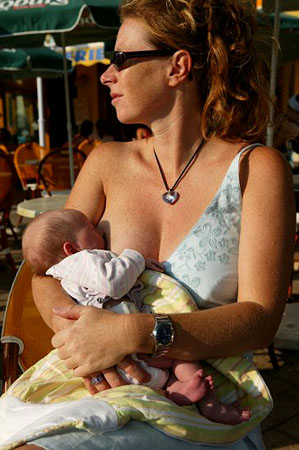
Breast
Feeding 
Menstuff® has compiled the following information on
breast feeding, especially in public. It wasn't that long
ago that men had to wear one-piece bathing suits to cover
their breasts. Many countries around the world aren't afraid
that their children will turn into perverts if they see a
woman's breast. Yet, in the United States, there are very
few nude beaches, and, in some states, a mother can be
jailed for breast feeding in public, or removed from an
airline before takeoff. It's often called public indecency.
There are only 15 states that have laws exempting
breast-feeding from public indeceny laws. 31 to pass a law
that allows mothers to breast-feed in any public or private
location, and 38 that have enacted some type of
breast-feeding legislation. Looking at this from the other
angle, 35 states have laws making public breast-feeding
illegal under indeceny laws, 19 that don't allow a women to
breast-feed in a public or private location, and 12 that
have enacted no breast-feeding legislation.
Except in some states and with some
airlines. - Editor
I don't know what you think about the sanitary conditions
of public rest rooms, but that's about the only safe place
in some states to hide the breast feeding activity from the
prudes. Is that where you would want your child to be
nurished? I wonder how many American children will become
perverts because they saw Janet
Jackson's nipple on television? I would say none.
However, the fear of a child seeing a nipple will, I'm sure,
produce a number of perverts. The Morality
Police (otherwise known as the Prude Police) are
dictating way too much public policy. It's time for that to
change.Related article: Porn
is a Conservatives' Thing


Lactating
Dads
15
Best Breastfeeding Stories of 2015 (PHOTOS)
Ivette
Ivens Photos
Target's
Open Breastfeeding Policy
Places
Moms Have Been Shamed For Breastfeeding
We're
not still nursing, we're just nursing
Viva La Boobies! 7 Things To
Know About Breasts
Breastfeeding Rates at Birth Up
Sharply, CDC Reports
Breast
Feeding Tips
- 8:52
Photo
of bride breastfeeding daughter during ceremony goes
viral
Breastfeeding:
What's the Big Deal
Breast-Feeding,
Intelligence Linked
Breastfeeding and Infant
Growth
Breast Milk Feeding Boosts
Preemies' IQ
Public Breastfeeding
New laws seek to protect
breast-feeding in public
Breast-Feeding Tied to Healthier
Arteries
Breast-Feeding May Have Dental Benefits
for Kids
Breast-feeding May Lower Risk of
Child Leukemia
Sharing Breast Milk May Pose
Risks
9 Breast-Milk Pumping Tips for New
Moms
Breast-Fed Babies May Be Smarter,
Richer Adults
Changing From Breast to Bottle
Feeding
New breastfeeding study shows most
moms quit early
HHS Blueprint to Boost
Breast-Feeding
Breast-Feeding Past Infancy:
'I'm Comforting Him'
Breastfeeding - How Long is Too
Long? Editor: When the child stops or
the breast dries up.
Facebook Policy Angers Nursing
Moms
Facebook Won’t Budge on
Breastfeeding Photos
The FDA and Breast-Feeding
Amercian Academy of
Pediatrics
Alyssa Milano questions why her
photo is more offensive than Kim Kardashian's
Breastfeeding Mom Graduation
Photo Goes Viral
Bills aim to ease breast-feeding in
public
Citizens Against
Breast-Feeding
Breastfed Kids
Become Social Climbers
Kate Hudson Breast Feeding in
Public
Suggestions for Breast Feeding
in Public
Nursing Mom Takes on
Starbucks
Driving and Breast-Feeding Nets
Charges
Rates in Other States
Extreme
Breastfeeding: When to stop?
The
Benefits of Breast-Feeding 4:00
Breast
Milk Flavor may Affect How a Child Eats
Taste
of Breast Milk May Affect a Child's
Feeding
Natural
Moms Talk Radio:
What Photos of Breastfeeding Are
Supposed to Look Like
Related Issue: Nipples,
Male Moms,
Baby Gaga,
Home
Birth
Resource: babychangingstation.com/breastfeeding/
Indecent Exposure?
New laws seek to protect breast-feeding in public.
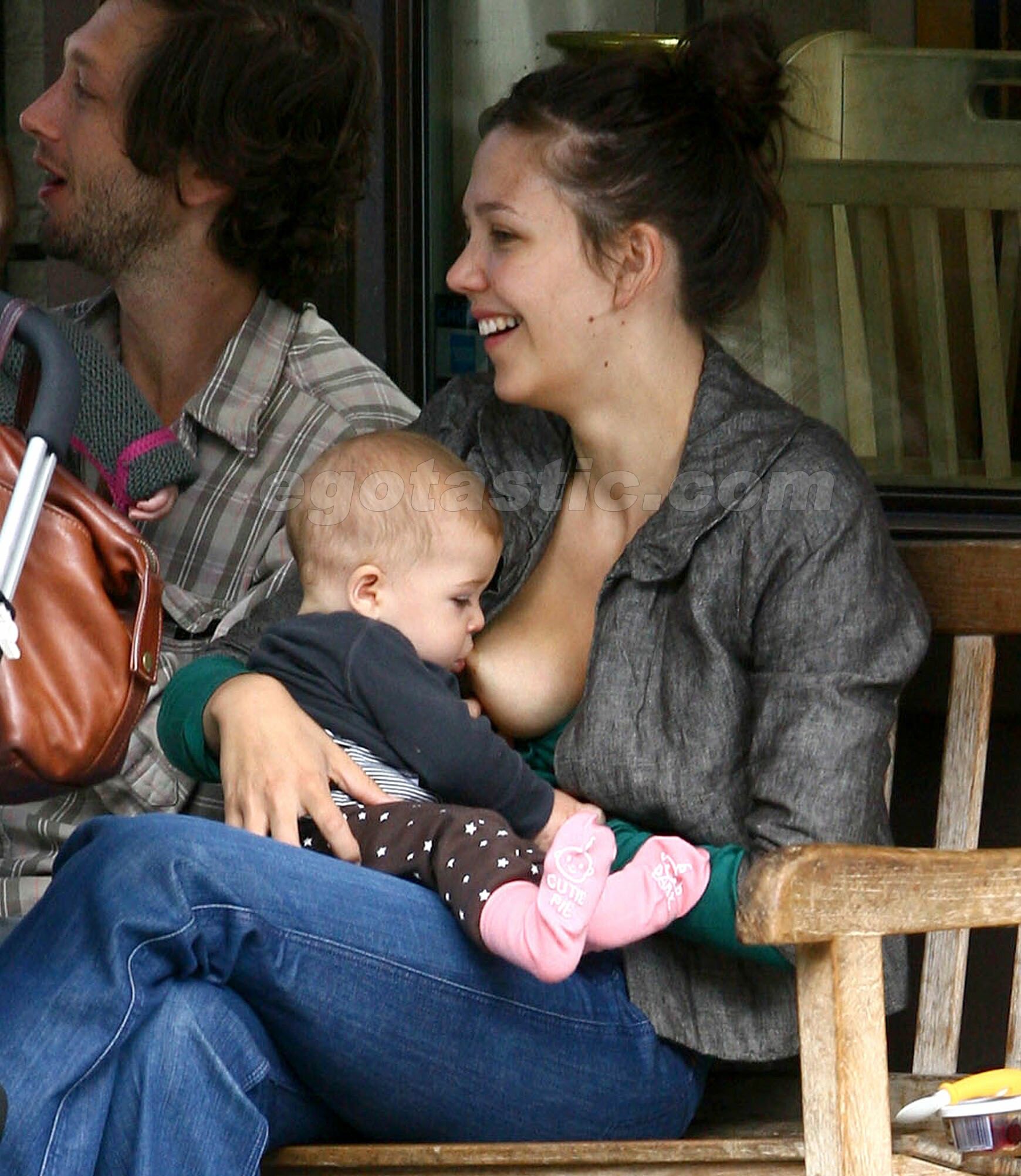
A few weeks ago, the actress Maggie Gyllenhaal visited a
public park in New York—and breast-fed her 8-month-old
daughter, Ramona. Kudos, right? After all, the American
Academy of Pediatrics recommends that moms nurse for at
least a year. Nope. Gawker.com posted a picture of a
partially exposed breast and called it a "momtroversy." The
photo is now on a "nude" Web site.
What gives? Even formula makers say "breast is best."
Nursing reduces a baby's risk of diarrhea, ear infections,
urinary-tract infections and bacterial infections (and
perhaps food allergies, obesity and diabetes). It also
lowers a mom's risk of breast and ovarian cancer—and,
since it burns 500 calories a day, helps her lose weight.
And it's free, while formula costs about $1,500 a year. Yet
new evidence shows that there has been a decline in the
number of women breast-feeding, reversing a steady increase
over the past three decades. "The culture does very little
to support mothers in what they need—information,
maternity leave, places to nurse," says Bernice Hausman,
author of "Mother's Milk."
A quarter century ago, one in four new moms tried
breast-feeding, and only one in 20 stuck with it for a year.
By 2002, almost three in four started breast-feeding in the
hospital. But last year, the number had dropped to 64
percent, according to a long-running Mothers Survey by
formula maker Abbott. At six months, the percentage of women
who were still nursing was only 30 percent; at one year, it
was only 19 percent. "Our real problem is duration," says
pediatrician Ruth Lawrence, chair of the AAP's
breast-feeding committee. The longer a woman nurses, the
greater the benefits to her and her baby.
Much of the problem seems to be that Americans associate
breasts with sex, not milk, and as a result, feel squeamish
about public nursing. (While two out of three Americans
think breast-feeding is the best way to feed a baby, a
quarter say they feel uncomfortable seeing women do it.) In
a study for the U.S. government, 48 percent of women said
they would feel uncomfortable nursing their own babies in a
park, store or mall. "We define breast-feeding as good, and
we define breast-feeding as disgusting. We have this split
personality about it," says Jacqueline Wolf, associate
professor of the history of medicine at Ohio University.
Even MySpace has recently removed photographs of mothers
nursing their babies.
Out of concern that not enough women are breast-feeding,
a growing number of states are passing protective laws and
policies. Today 38 states give women the explicit right to
nurse in public, and 23 states exempt it from
public-indecency laws. Twelve states have laws addressing
women's right to use a pump to express milk at work. And the
governors of New Mexico and Oregon recently signed similar
legislation, which gives moms (unpaid) lactation breaks and
a clean and private area to pump (not just a bathroom
stall). Federal legislation may be on the way. In May, U.S.
Rep. Carolyn Maloney re-introduced her Breastfeeding
Promotion Act, which would amend the Civil Rights Act of
1964 to protect breast-feeding and to provide a tax
incentive to businesses that establish lactation areas.
In a recent survey, the International Formula Council
asked moms with kids under 12 months why they would not
breast-feed. Most cited medical reasons, followed by going
back to work, problems with the baby's latching on and
concerns about the baby's not getting enough food. The AAP's
Lawrence believes breast-feeding is all about
confidence.
Part of the confidence comes from feeling comfortable to
nurse. A woman's right to breast-feed—and a baby's
right to the best nutrients—"shouldn't be abridged
because some people are squeamish about what they're
seeing," says Chris Musser, who started a blog called The
Reluctant Lactivist after a grocery-store manager told her
to cover up while she was feeding her then 2-month-old son,
Luc. After all, "into the 18th century, women who breast-fed
were painted," says pediatrician Naomi Baumslag, author of
"Milk, Money and Madness." "They were considered beautiful."
Maybe Maggie Gyllenhaal should head back to that park.
Source: www.msnbc.msn.com/id/18999858/site/newsweek?GT1=10056
Breast-Feeding Tied to Healthier
Arteries
July 8, 2015 (HealthDay News) -- Young women who breast-feed
may have healthier-looking arteries years later, compared
with those who bottle-feed their babies, a new study finds.
It has long been reported that breast-feeding is the
healthiest option for...
Source: www.webmd.com/parenting/baby/news/20150708/breast-feeding-tied-to-healthier-arteries-in-middle-age
Breast-Feeding May Have Dental
Benefits for Kids
June 15, 2015 (HealthDay News) -- The more babies
breast-feed, the less likely it is that they will develop
any kind of misalignment in their teeth later on, a new
study shows. But pacifiers can negate some of that potential
benefit, even if the children are...
Source: www.webmd.com/parenting/baby/news/20150615/breast-feeding-may-have-dental-benefits-study-suggests
Breast-feeding May Lower Risk of
Child Leukemia
June 1, 2015 (HealthDay News) -- Breast-feeding -- even
for a short time -- may lower a baby's later risk of
childhood leukemia, a new study suggests. The researchers
found that babies breast-fed for at least six months appear
to have a 19 percent lower ...
Source: www.webmd.com/parenting/baby/news/20150601/breast-feeding-may-lower-risk-of-childhood-leukemia-study
Sharing Breast Milk May Pose
Risks
April 30, 2015 (HealthDay News) -- Women may be using
shared breast milk from friends and family, but they don't
always consider the risks involved with providing donor milk
to their babies, a new survey shows. As many as one-third of
women don't...
Source: www.webmd.com/parenting/news/20150430/sharing-breast-milk-may-pose-risks-women-havent-considered
9 Breast-Milk Pumping Tips for New
Moms
When you’re a mom who breastfeeds, there may be
times you need to be away from your baby. That’s when a
breast pump comes in handy! It lets you store milk your
little one can drink later, and it signals your body to keep
making milk. Never pumped before? These tips will make it
easier. If you’re...
Source: www.webmd.com/parenting/baby/features/milk-pumping-tips
Breast-Fed Babies May Be Smarter,
Richer Adults
March 17, 2015 (HealthDay News) -- Breast-fed babies may be
smarter, better educated and richer as adults, a new study
by Brazilian researchers suggests. "Breast-feeding is
associated with improved performance in intelligence tests
at age 30 and also...
Source: www.webmd.com/parenting/news/20150317/breast-fed-babies-may-be-smarter-richer-adults-study-suggests
Changing From Breast to Bottle
Feeding
Maybe your baby finally learned how to fall asleep on
her own, so she doesn't need to nurse at bedtime anymore.
Maybe she's less excited about breast milk since you've
offered finger foods. Or maybe your plan to pump milk at
work every day is tougher than you thought. There are many
reasons why you...
Source: www.webmd.com/parenting/baby/features/weaning-from-breast
Kate Hudson Breast Feeding in
Public
While filming for “The Skeleton Key”, Kate Hudson
offered people from the set a picturesque view of
herself.
When not busy working, she was breastfeeding her
firstborn, Ryder Russell Robinson, and chatting with the
director. The actress confessed she found the experience
quite funny.
She declared for Britain's OK! Magazine:
"It was funny when I was breastfeeding because every
three hours I'd go to the trailer to breastfeed or pump.
It became a joke in the end; it was hard but it got to
the point where I didn't want to go back to the trailer so
I'd just bring the baby out and I'd sit and I'd talk to the
director and just breastfeed him while chatting."
Source: news.softpedia.com/news/Kate-Hudson-Breast-Feeding-In-Public-13994.shtml
Breastfeeding Rates at Birth Up
Sharply, CDC Reports
The percentage of women who breastfed their newborns
increased by about two percentage points from 2008 to 2009,
making it the largest one-year rise in a decade, according
to a CDC report released on Wednesday, the Los Angeles
Times' "Booster Shots" reports.
Citizens Against
Breast-Feeding
There are places in the world where breast-feeding a child
in public is as unremarkable as a stroll in the park or
chatting with a friend; where people aren't discomfited by
the sight of a bared breast being employed for its natural
purpose.
America is not one of those places.
Though opinion is virtually unanimous among health
professionals that breast milk is healthier for children
than bottled milk or formulas, studies show that the
majority of American women do not breast-feed their babies
after leaving the hospital, even in the privacy of their
homes. Public breast-feeding is rarer still. Many Americans
admit that the very idea of it makes them nervous.
Advocacy groups are trying to change all this by
educating the public and pushing for clarification of state
laws to protect women's right to breast-feed when and where
they choose. Though no states prohibit breast-feeding per
se, some have laws that could be construed as limiting that
right. The La Leche League notes that oftentimes women are
told to leave public places like malls and libraries on the
grounds that breast-feeding is "indecent." This is not only
a violation of their rights, says the League, it's an
absurdity.
Enter a group called Citizens Against Breast-Feeding.
Self-proclaimed members of the organization were first
sighted outside the Republican National Convention, handing
out leaflets advocating a total ban on breast-feeding,
public and private. Simultaneously, an email tract began
circulating that laid out the "philosophy" behind it:
Republican Convention Must Ban Breastfeeding
Now:
Over 200,000 American citizens have signed a petition urging
Congress to declare breastfeeding unlawful. This primitive
ritual has and continues to be a violation of babies' civil
rights. It's an incestuous relationship with mothers leading
to moral decay. Women enjoy an erotic experience that
imposes oral gratification on innocent infants after birth.
Their reprehensible behavior teaches children illicit sex,
subsequently manifesting addiction to promiscuity.
Repbulicans: choose a candidate who supports our cause!
Tess Hennessy, Founder-Director
Citizens Against Breast-Feeding
P.O. Box 55741
Phoenix, AZ 85078
New York Office: 212.330.7675
Some who encountered this message dismissed it instantly
as unreal, while others dialed the number to find out more
and, to their dismay, heard a recorded message not only
affirming the existence of the group but soliciting workers.
For all we know, a few people may have even applied.
"Thank you for calling Citizens Against
Breast-Feeding, a grassroots organization that persuades
women to abolish this incestuous act of immoral
perversion. We are privately financed and therefore not
seeking donations. However, you may wish to apply for a
position with one of our field offices in New York,
Chicago, or Los Angeles, now hiring. If so please leave
your name, address and phone number after the beep."
– Actual recorded phone message
But it was, in fact, a prank.
David Mikkelson, half of the husband-and-wife team that
runs the ever-popular Urban Legends Reference Pages, smelled
a hoax right off the bat and confirmed it quite easily by
establishing that the phone number in the message is
associated with Alan Abel, a notorious hoaxer who once
headed up a campaign demanding that "all animals should wear
clothing for the sake of decency."
Lampooning prudishness is one way of drawing attention to
the issue (in a reverse-psychology sort of way), but
certainly not the best way to effect real change. To anyone
seriously interested in campaigning for breast-feeding
rights and related issues or just learning more about them,
I commend About's expert Guide to Pregnancy and Childbirth,
Robin
Weiss .
She's the real thing.
Take
the poll
:
"Is there anything wrong with breast-feeding in public?" On
3/14/06, of 11,882 respondents, 32% said it shouldn't be
allowed in public, 66% it should, and 1% couldn't
decide.
Source: By David Emery, urbanlegends.about.com/library/weekly/aa082100a.htm
Breast Feeding in Public: A
Nursing Mom takes on Starbucks
It was late on a summer afternoon in a nearly-empty
Starbucks in Silver Spring, MD. Lorig Charkoudian was
quietly nursing her 15-month-old daughter, Aline, when the
coffee shop's manager approached her and requested that she
take her baby into the bathroom to breast feed.
The 31-year-old mom couldn't believe what she was
hearing. "I thought it was disgusting to suggest I breast
feed in the bathroom and my daughter is uncomfortable with a
blanket over her head," she says. A month earlier, a
customer had complained about another mom who was
breast-feeding in the store, so the manager decided to
pre-empt any complaints, says Charkoudian.
As it turned out, Charkoudian was exactly the wrong
person to confront about nursing in public. She has a PhD in
economics and works as a conflict resolution researcher and
trainer. In her eyes, breast feeding - besides being the
healthiest choice for her baby - is good for society. Among
other things, breast-fed babies have a lower incidence of
illness and disease, which, in the long run, saves society
on health care costs.
The manager also didn't bargain for Charkoudian's
response. When she discovered that Starbucks was in
violation of Maryland state law - which allows women to
breast-feed in public or private locations without
restriction - Charkoudian immediately took the matter to the
top.
"I am writing to make you aware that Starbucks' policy on
breast-feeding in its coffee houses is against the law in
Maryland," her two-page letter to Starbucks Regional
Vice President Dean Torrenga began. In a dig at the national
coffee chain - known for its public support of progressive
causes and a corporate pioneer for offering health benefits
to part-time employees - Charkoudian asked Starbucks to
retrain employees and establish a "clear policy that women
can breast-feed in its coffee houses without being limited,
restricted or asked to hide."
Big brothers and sisters joined the "nurse-in" with signs
and dolls to help drive the point home.
When she didn't receive a response within two-weeks,
Charkoudian got mad. "To go into the bathroom implies this
is shameful or should be hidden," she says. Then Charkoudian
got organized.
She spoke with other moms, went online to complain to
parent listservs and within a few days organized a
"nurse-in" back at the coffee house. About 30 women who had
never met Charkoudian but were fed up with negative
attitudes about breast feeding gathered at the store last
August. Outside, about twice as many supporters - husbands,
mothers-in-law, uncles, older children - held signs saying
"could you drink your latte in the bathroom?"
"The more difficult it is to breast-feed, the fewer the
women who'll do it," says Charkoudian, and a 2002 study by
the Centers for Disease Control backs her up. The study,
published in the Journal of Human Lactation, found
that 30 percent of adults thought babies should be fed
solids by three months and women should not still be
breast-feeding their babies at their first birthday -
contradicting advice from the American Academy of
Pediatrics.
In 1998, 45 percent of African American mothers breastfed
in the early postpartum period, compared to 66 percent of
Hispanic mothers and 68 percent of white mothers, according
to a 2000 study by the office of the U.S. Surgeon
General.
"Even with new developments in formula, it cannot match
breast-milk. It's the ideal food for babies," says Ruowei
Li, an epidemiologist with the CDC who says Charkoudian's
negative experience at Starbucks isn't uncommon. "The public
really needs to be educated. Breast feeding is beneficial
not only for babies, but mothers and the entire population.
Breast-fed babies have lower incidence of ear infections,
less diarrhea, less respiratory infections. It saves society
money - not having sick babies."
Starbucks did respond eventually. In a letter to
Charkoudian, the regional vice president says the company
will comply with Maryland law and instruct its employees
accordingly. Starbucks Media director Audrey Lincoff says
"breast-feeding mothers are welcome in our stores."
But that hasn't satisfied Charkoudian. She has created a
website to encourage Starbucks to enact a national policy
encouraging breast-feeding moms to nurse babies in its
stores. On the site - www.nurseatstarbucks.com -- parents
can download a letter to Orin C. Smith, Starbucks' chief,
and even send it from their babies.
Charkoudian challenges Starbucks to be a corporate leader
in its public breast-feeding policies.
"Dear Mr. Smith," the letter states. "I like to drink my
mama's breast milk. It tastes good and it is so good for me.
I like the fact that when my mama takes me places, she feeds
me when I am hungry, which is a lot, since my tummy is so
small. Sometimes she goes to Starbucks. When she does, I
don't want to be hungry. I want to be able to nurse there,
too. I don't like nursing under a blanket because I can't
see my mama and my mama can't see me and it gets hot and
uncomfortable under there. I really don't like nursing in
the bathroom. That's gross."
Charkoudian's website explains that in an effort to avoid
harassment while nursing, "women find themselves squatting
in bathrooms, fumbling under blankets, trying to cover a
baby's head with the baby struggling." The reality - she
notes "is that when most women breastfeed, those around
cannot see much of her breast at all because the baby's head
is covering it."
Check out the "3-Minute Activist" on the Promotion of
Mother's Milk website - www.promom.org
.
The site provides simple steps to get the word out about
negative portrayals of breastfeeding in the media and
society in general.
Go to www.nurseatstarbucks.com
and email a letter from the site encouraging Starbucks to
adopt nursing-friendly policies in all of its stores.
Charkoudian has received more than 400 emails at the
site. Some are genuinely gung-ho, and many supporters have
used her website to write to the company. One woman wrote of
her humiliating experience on an airline: "I asked for a
seat change (I was sandwiched between two men) so I could
nurse comfortably. I suggested putting me near a female
passenger. The male attendant's attitude was rude and nasty.
He told me that was not their problem."
But not all of the e-mails are encouraging, and dozens
are vitriolic in their anger about her campaign. "Go take
your shirt off in one of thousands of others places you can
(and I'm all for women taking their shirt off)," wrote one
man. "And spend your time on a real worthwhile cause."
The hostile e-mails show Charkoudian that more needs to
be done - by government, companies and the public to support
nursing women. "I never expected it to be this big," she
says. "There was an intense emotional response to this.
We're not boycotting Starbucks. We're challenging them to be
a corporate leader."
Source: By Lisa Newman, www.parentsaction.org/learn/features/breastfeeding/
Bills aim to ease breast-feeding in
public
'If my child is hungry, I should have that right.'
Evelyn Garner Araujo, a Jackson mother of three, has had
to pump breast milk in a public restroom to feed her
child.
A waitress has refused to serve Nancy White because she
breast-fed her child under a blanket. White said she was
surprised by people's reactions the first time she fed the
oldest of her three children in public. "I didn't know that
it was an offense to breast-feed in public," White said. "If
my child is hungry, I should have that right. I'm sensitive
to other people. I'm very discreet."
A series of bills proposed in the Legislature may give
mothers more rights to nurse in public.
What's Next?
A subcommittee of the Senate Public Health and Welfare
Committee will meet at 2:30 p.m. today (January 23, 2006) in
Room 409 at the Capitol.
Senate Bills 2419 and 2352 and House Bill 527 would
exempt breast-feeding mothers (but not lactating
fathers) from Mississippi's public indecency law,
protect breast-feeding mothers from discrimination in the
workplace and ensure that licensed child-care facilities
accommodate breast-feeding mothers and their children.
Breast-feeding in public is a misdemeanor under the
current law, punishable by up to six months in jail or a
$500 fine.
Sen. Hillman Frazier, D-Jackson, a proponent of the bill,
said public indecency laws should not apply to
breast-feeding women. He said forcing women to use public
restrooms is unsanitary and unfair."I wouldn't want to drink
a milkshake in a public bathroom, let alone feed my child,"
Frazier said.
The bills seem to face little opposition in either
chamber. The measures have bipartisan support, including
chairmen of the public health committees in both
chambers.
Senate Public Health Committee Chairman Alan Nunnelee,
R-Tupelo, said his committee will give the bill serious
consideration.
"Breast-feeding has been shown to have tremendous health
benefits," Nunnelee said. "There should not be legal
obstacles to a mother wanting to breast-feed her
children."
Dr. Becky Saenz, director of the Mississippi
Breastfeeding Medicine Clinic in Madison, said
breast-feeding laws in other states have increased the rate
of breast-feeding, which is good for mother and baby.
For children, Saenz said, breast-feeding reduces the risk
for dozens of diseases, including asthma, lymphoma, leukemia
and diabetes. For mothers, she said, it reduces the risk of
several types of cancer including breast cancer.
She said pressures not to breast-feed in public force
many of her patients to abandon breast-feeding before the
six months recommended by the American Medical
Association.
"Mothers and children should be able to feed whenever and
wherever the child gets hungry," Saenz said. "They should be
allowed to breast-feed wherever a bottle-feeding mother can
feed."
Araujo, White and other mothers who support the bill say
they are discreet when they feed in public and people around
them typically cannot tell they are feeding.
Araujo said she does not think anyone would have her
arrested for feeding in public, but she's been asked to
leave a public school classroom where she was
volunteering.
Araujo and others say the legislation, if passed, would
make breast-feeding in public more acceptable and make it
easier to choose a healthier option for their babies.
"Breast-feeding your child is very empowering," Araujo
said. "The more people become accustomed to it, the less
discomfort they will have with it."
Source: By Joshua Cogswell, E-Mail,
www.clarionledger.com/apps/pbcs.dll/article?AID=/20060123/NEWS010504/601230325/1038
Suggestions for Breast Feeding
in Public
Breast-Feeding is a gift that the mother gives her baby.
Breast-feeding in public places can be embarrassing for a
mother.
When in public, wear clothing that allows easy access to
breasts with as little exposure as possible.
Don't wait until the baby is frantic and start crying to
breast-feed. Crying babies attract attention to both the
mother and baby.
Turn away from the public as much as possible. Use a
duppatta/scarf, magazine, or another person to avoid public
exposure.
Turn the chair to the wall, if necessary to breast-feed
the baby. Source: www.medindia.net/patients/patientinfo/breastfeed_public.asp
Facebook
Policy Angers Nursing Moms
Web-savvy moms who breast-feed are irate that social
networking sites like Facebook and MySpace restrict photos
of nursing babies. The disputes reveal how the sites'
community policing techniques sometimes struggle to keep up
with the booming number and diversity of their members.
Facebook began as a site just for college kids, but now
it is an online home for 140 million people from all over
the world. Among the new faces of Facebook are women like
Kelli Roman, 23, who last year posted a photo of herself
nursing one of her two children.
One day, she logged on to find the photo missing. When
she pressed Facebook for an explanation, she got form
e-mails in return.
Source: news.aol.com/article/facebook-policy-angers-nursing-moms/291439?icid=200100397x1216507268x1201006630
Comments: Is Facebook
against breastfeeding and/or breasts? What are they afraid
of - that millions of viewers will go blind? We get to watch
someone commit suicide, we see mutliatoins, hangings, brutal
fights, war, you name it but they are afraid of the world
seeing one of the most loving, nurturing situations human
beings can be exposed to - a woman breastfeeding a child. I
realize that the American culture still isn't comfortable
with seeing a nipple and in some states and airports, the
woman is required to go to the filthy airport bathroom to
nurse. The Dr. Spock start this whole fear but saying, I
believe in the 70's, that you only needed to breast feed for
a month before you put your child on Simulac. Breastfeeding
has gotten a bit more popular but women who do it in public
are often ridiculed, scorned and maligned. Is it any wonder
that American children are deprived of this healthy aspect
of growing up that children in many other cultures enjoy. An
American child gets an average of one year to breast feed
and then it's over while the average world wide in 4.6
years. The AVERAGE. Get a grip, Facebook. And, Get a Grip
America to demand the return of these nurturing photos to
the Internet. - Gordon Clay
Alyssa
Milano questions why her photo is more offensive than Kim
Kardashian's
Is Alyssa Milano breastfeeding more or less offensive than
Kim Kardashian posing nude?
That's the question the 41-year-old actress is raising.
On Nov. 12 after Kim Kardashian's Paper Magazine nude photos
attempted to "break the internet," Milano tweeted it and
compared it to her own controversy.
The 'Mistresses' star posted a breastfeeding selfie and
got some heat over it showing part of her boob and quoting
writer Milan Kundera, "Ah, the joy of suckling! She lovingly
watched the fishlike motions of the toothless mouth and she
imagined that with her milk there flowed into her little son
her deepest thoughts, concepts, and dreams."
PHOTOS: Olivia
Wilde and More Breastfeeding Moms
Even though she did not understand why her photo was more
offensive, she did give Kim, 34, some credit for her latest
pics.
Since Milano raised the question, she has inspired a
social breastfeeding selfie movement. Many moms have tweeted
at her with their own photos of breastfeeding, and she
retweeted a few.
Milano and her agent husband David Bugliari welcomed
their daughter Elizabella on Sept. 4. The couple also has a
son, Milo Thomas, 3.
Watch Halle Berry share her breastfeeding story in the
video.
Because Kim's butt wwon't make a
man turn to stone, according to the Bibler, but a breast
might. - Gordon Clay
Source:
www.aol.com/article/2014/11/16/alyssa-milano-photo-offensive-kim-kardashian/20994410/?icid=maing-grid7%7Cmain5%7Cdl2%7Csec1_lnk3%26pLid%3D564773
Just imagine. You're at a
dinner party. A lot of conversation going on. It's time to
eat, Which scenario would you pick: (1) You at
cofvered with a sheet and have to eat in the dark, hidden
away from the others. (2) You have to go to the
bathroom and eat in an individual stall. 02 (3) Your
mother takes her breast out at the tablle, everyone asks as
if this were totally nastural (which it is in many culturs),
and you drink your fill. - Gordon
Clay
Rates in Other States
The rates of breast-feeding in a sampling of states that
have laws exempting mothers from public indecency laws. The
average rate of breast feeding in the world is 4.6
years. Some are still breast feeding at 6 years.
- Florida: Breast-feeding initiated — 71.6
percent; Breast-feeding at 6 months — 33
percent
- Alaska: Breast-feeding initiated — 88 percent;
Breast-feeding at 6 months — 48.1 percent
- Illinois: Breast-feeding initiated — 63.8
percent; Breast-feeding at 6 months — 33.7
percent
Source: U.S. Centers for Disease Control
and Prevention
Breast-Feeding
Past Infancy: 'I'm Comforting Him'
A Mom Talks About Her Decision to Continue Breast-Feeding
Her Older Children. Includes 8:09 video Average age to ween
a child around world is 4. Then a bunch of psychologists
whine about it. 6 is not unusual. 1 to 6 months is.
Source: abcnews.go.com/Health/Story?id=6551439&page=1
Driving and
Breast-Feeding Nets Charges
Police in Ohio say a woman has been charged with child
endangering after another motorist reported she was both
breast-feeding a youngster and talking on a phone while
driving.
Police in the Dayton suburb of Kettering say the caller
told them he saw the woman Thursday.
Officer Michael Burke says authorities used a license
plate number to track down 39-year-old Genine Compton.
He said the woman told officers she was breast-feeding
and wouldn't let her child go hungry.
Burke said the legal concern is that Compton had a child
in her lap while driving, not that she was breast-feeding in
public.
He said the child was under 2 years old.
Police say the woman faces up to 180 days in jail and a
$1,800 fine if convicted of the misdemeanor.
Source: news.aol.com/article/breast-feeding-cell-phone-mother/362780
Viva
La Boobies! 7 Things To Know About Breasts
Breasts are amazing – they are beautiful, they nourish
babies, and they have an intelligence of their own.
Breasts have so many incredible benefits for the health
of humanity, the power of women, and the nurturing of the
future generations.
Your breasts deserve a medal of honor – plus
nurturing, pampering, and respect.
Yet, our breasts are suffering from the dangerous effects
of rising environmental toxins in our food, water, air, and
toiletries, degrading media, restrictive fashion, and lack
of empowering health education for women.
I had a dream a few weeks ago that I was at a conference
and the organizers asked me to get up on stage and speak
about breast health. They said it was vital that we get more
people to understand and value the importance of caring for
our healthy breasts and that in order to get people’s
attention I needed to be topless to speak. While I was still
pondering whether or not I felt comfortable with being
topless on stage, I woke up.
A few days later Angelina Jolie announced her decision to
have her healthy breasts surgically removed because of her
potential cancer risk. This action has inspired me even more
to realize how vital it is that we join in this conversation
and speak about how to naturally care for our breasts, how
our environment, diet, and lifestyle impact our health, and
why breast health is more important than every before.
Thus, my intention is to share positive inspiring
information to support women to love their breasts and learn
about ways to naturally care for our amazing breasts.
Let’s uplift breasts to the status level they
deserve!
7 Amazing Things to Know About Breasts
#1 Breasts want freedom.
Bras restrict the movement of lymphatic fluid through the
breasts, underarm, and shoulders, thus causing toxins to
build up in the breast tissue. Underwire bras are the worst
culprit, as the metal also can disrupt the energy flow
through the breast area.
A recent French study has shown that women who don’t
wear bras actually have perkier breasts even as they
age.
Exercising, dance, and rebounding without a bra also
allows the body’s movements to support lymphatic flow
and proper drainage of the breasts. The natural movement of
the breasts as the body exercises and moves is another
essential component to lymphatic health in the breasts.
#2 Breasts need massage.
There is no muscle tissue in a women’s breasts, so
breasts need assistance to enhance circulation through the
breast. A woman’s breasts are mostly fat tissue along
with milk ducts, connective tissue, nerves, and lymph
glands.
Self breast massage is an important regular practice for
women to support their blood and lymph circulation and
reduce build-up of toxins and hormones in the fatty tissue
of the breasts.
Massage your breasts daily with a natural cold-pressed
vegetable oil, such as coconut, almond, or jojoba oil. You
can also add pure essential oils such as rose, jasmine, or
clary sage to your massage oil base.
I’m not talking about “man-handling” here,
I’m talking about gentle self massage in which you get
to know what your breasts feel like, notice any changes, and
use gentle lymphatic and circulatory movements to enhance
health.
#3 Breasts are hot.
It has been well-documented that a woman’s breasts
will synchronize with her newborn baby to become the perfect
temperature. When a mother and baby are skin-to-skin
postpartum, her breasts will naturally adjust their
temperature to regulate the baby’s body temperature
optimally.
A mother of twins will have each of her breasts match the
ideal temperature for each one of her twins. A women’s
breasts are more reliable and efficient than any baby
warmer. So breasts are totally hot – just not in the
way people usually talk about.
#4 Breastmilk has a gazillion medicinal uses.
Breastmilk is pretty much the most amazing food substance
available to mankind.
Mother’s milk is completely unique and not possible
to replicate (despite what you may have heard from the
formula companies). It actually changes minute by minute,
day to day, to provide exactly the right nourishment and
immunities that a baby needs as determined by the breast
through receiving information from the baby’s saliva on
the areola.
There are over 400+ identified nutrients in human breast
milk, including probiotics and an abundant source of stem
cells. The first milk that comes out is colostrum, which is
rich with immune factors and is considered to be
“liquid gold”, and extremely important for the
life-long health of the baby.
Breastmilk is also used by wise mamas for many purposes
including putting on diaper rash, earaches, pink eye, sore
throats, and many other healing needs. When a women
breastfeeds the breastmilk bathes her milk ducts as it
passes through to her baby, thus providing increased breast
health and preventing breast cancer in direct relation to
how long she nurses.
#5 Breasts are energy centers.
Traditional Chinese Medicine is a complete system of
health that has been practiced for thousands of years, based
upon the movement of energy through the body on the
meridians (energy lines) and acupoints (nodes of energy on
the meridians). There are six meridians that run through the
breast area, and three of them are the Kidney, Liver, and
Stomach meridians where most breast lumps and cancer
develop.
TCM treats breast cancer by addressing the energy
stagnation and movement of qi. Acupuncture and TCM are
holistic ways to promote breast health and can be used in
combination with other health care treatments as well.
Massaging the acupressure points along the meridians, or
holding these energy points around the breasts, can help
with promoting breast and whole body health and
vitality.
Underwire bras can also interfere with the energy moving
through the meridians in the breasts, another reason to let
your boobs go free, or invest in a soft supportive natural
fiber bra.
#6 Breasts are a lot like canaries.
You’ve heard about the canary in the coal mine?
Miners would take canaries down in the mines with them,
because the birds were so sensitive that if the environment
was toxic the canaries would die, and then the miners would
know to get out of there immediately! Breasts are extremely
sensitive, they receive information from the environment and
their tissues collect toxins and hormones, like jet fuel and
flame retardants.
When breastfeeding, the saliva from the baby is absorbed
into the areola and the breasts then immediately respond by
providing the nutrients and immune factors that the baby
needs based upon the breast’s incredibly sensitive
receptors.
Breast cancer is now the most common form of cancer for
women in the US, and it’s not because breasts or our
genes are the problem. Our breasts are the canaries letting
us know that our environment is toxic and we must make
changes in our health, diets, exposure, and detox. Due to
the over 70,000 chemicals now used in the US over the last
100 years, we are living in a toxic soup and exposed to
chemicals in our air, food, water, homes, cars, clothes, and
more. Our breasts are letting us know that we need to create
a healthy change for our longevity and the future
generations.
#7 Breasts are beautiful.
Your breasts are perfect for you. All kinds of breasts
are beautiful. Breasts change in shape and size over life,
and that’s okay. Some men like large breasts, others
prefer small breasts, and some like medium sized. Whatever
shape or size of your boobs is just right. Love your
breasts! They have superpowers, they are intelligent, and
they are amazing!
In Mongolia, when a baby fusses, everyone lifts up their
shirt and shakes their breasts for the baby, and the baby
calms down and looks around amazed. Everyone laughs and
smiles shaking their boobs, including mom, grandma, and
grandpa too! So smile and love your boobs, they are
awesome.
Viva La Boobies!
Source: mytinysecrets.com/viva-la-boobies-7-things-to-know-about-breasts/
Breastfeeding
Mom Graduation Photo Goes Viral
Jacci Sharkey juggled motherhood and schoolwork for most of
her three and a half years at the University of the Sunshine
Coast (USC) in Queensland, Australia. So the 24-year-old
mother of two thought it only fitting to thank the
university for supporting her and her family (who sometimes
even went to lectures with her) by sharing a photo in which
she was breastfeeding her then-6-week-old son Alek in her
cap and gown, just before the graduation ceremony.
"I’m extremely proud that with the support of the
uni, during my degree I was able to have 2 babies and still
finish my degree," Sharkey explained in a note with the Oct.
2 photo. “Thanks USC!”
Now the school can thank her for shining the spotlight on
them. Since the university posted her photo on Facebook on
Nov. 2, it’s gone viral, with 184,000 likes and more
than 5,400 shares.
"I thought I’d be really happy if it got 100 likes,
and then it’s just gone out of control," the human
resources management major, whose other son, Ari, is 20
months old, told Australia’s ABC News. “I never
expected it to go crazy!”
Also unexpected was the idea that she had sent it to
promote breastfeeding. “It wasn’t a statement
[on breastfeeding] or anything like that,”
Sharkey insisted. “I would have sent the same picture
to the uni had [Alek] had a bottle or a
sandwich.”
The thought she wanted to share was “just the fact
that I’m a mum, it’s not I’m a breastfeeding
mum, just I’m a mum,” she explained. “It was
really a message of thanks and that other mums can do it as
well.”
Elaborating to the Daily Mail Australia, Sharkey —
who currently works as a wedding and events planner —
declared, “You don’t have to give up the career to
have kids, and you don’t have to give up kids to have
the career … you can have it all.”
Nevertheless, the photo has been a boon to breastfeeding
proponents. “Breastfeeding moms feel excited about
seeing that,” La Leche League’s Diana West tells
Yahoo Parenting. “In our world, breastfeeding is not
considered acceptable everywhere. It’s changing a lot,
but it’s still an adjustment for a lot of people to
accept. A picture like this shows that this is normal. And
it’s a cool way to show her bringing together her two
worlds.”
With all the recent celebrity breastfeeding photo shares
on social media, including ones from Alyssa Milano, Jaime
King, and Gisele Bündchen, West says she’s not
surprised that Sharkey’s went viral. “It’s
breasts,” she admits. “They’re always going
to be sexualized and get notice, but this image still serves
the breastfeeding cause well because the more we talk about
it, the more we discuss the issues around it.”
Sharkey says she has gotten some negative feedback about
breastfeeding in public — much like Karlesha Thurman,
25, who received a slew of Twitter slams in June after a
photo of her breastfeeding her 4-month-old daughter during
her graduation from California State University, Long Beach,
was posted on social media. But the overwhelming response
has been positive.
"Studying is HARD," Kristie Morris commented in one rave
post on USC’s Facebook page. "Studying with kids is
HARDER, studying whilst growing a baby, giving birth and
breast feeding is EXTREMELY HARD!!! Doing all of this while
staying healthy for 2 physically, mentally and getting to
the finish line is a massive achievement. BE SO PROUD
MUMMA!!!!"
Echoed Larissa Misa Johnson: “I congratulate her for
having the courage to stand up and get a picture for her
work. I’m not a mother so I don’t understand how
hard it must be to both study and have a child hanging off
your boob, it must be really hard. All this picture is doing
is showing support and encouraging mothers that they can
still get both support and study at the same time. How many
mothers out there have sacrificed their career to bring up
their child?”
The reason this image resonates with so many is that
it’s a symbol, explains Vicki Shabo of the National
Partnership & Women and Families. “This photo
encapsulates the dual demands placed on women increasingly
taking on the role of breadwinners in families and also
committed to giving their kids the right start,” she
tells Yahoo Parenting. “It shows a lot of the dualities
women face every day.”
Source: www.yahoo.com/parenting/breastfeeding-mom-graduation-photo-goes-viral-101773551012.html
What Photos
of Breastfeeding Are Supposed to Look Like
The most recent picture to raise eyebrows (and get
fingers typing) was Natalia Vodianova’s Instagram
picture of her nursing her baby in the nude. In the midst of
the praise for the beauty of the picture, some have gone so
far as to say they are appalled by the image -- just as
people were appalled when Gisele shared a shot of her
breastfeeding while getting her hair and makeup done for a
photo shoot, or trashed Ms. Kerr or Ms. King for sharing
their photos because either they “weren’t
appropriate” or shouldn’t have been shared.
As Alyssa Ashton wrote for Canadian Living about Natalia
Vodianova’s recent photo, “No mum looks like this
when she breastfeeds. Her hair and make-up isn’t
usually done. She isn’t posing seductively. And she
certainly isn’t breastfeeding in the nude. I hate this
image because it presents breastfeeding in an inaccurate
fashion.”
Ms. Ashton’s comments highlight what has become a
minefield for women sharing breastfeeding photos in public
in hopes of either normalizing breastfeeding or simply
sharing a moment: No matter what the picture is, or who
shares it, it’s wrong. These pictures are too sexy. Too
formal. Too stiff. Shouldn’t be shared in public.
Unfair to mothers who don’t have access to the same
resources as these models. Glamorize breastfeeding.
Sexualize breastfeeding ... In short, they don’t
“look” like breastfeeding is “supposed to
look like.” It’s not just celebrities either.
Jamie Lynne Grumet from I Am Not the Babysitter was
catapulted into the public eye with the infamous Time cover
of her nursing her then-3-year-old standing up. People
repeatedly stated the image wasn’t a “good
representation” of breastfeeding.
What I’d like to know is, what is breastfeeding
supposed to look like?
Is it just this lovey-dovey moment between mother and
child as they’re curled up on the sofa gazing at each
other? That’s a wonderful moment (one I’ve
experienced many times), but it’s certainly not the be
all and end all of breastfeeding. I can return to what Ms.
Ashton wrote and tell you that I have nursed in all the ways
she mentions, including the come hither look (you know, the
“Hey baby, let me put this baby to sleep so we can have
some fun!” look). I also smiled when I saw Ms.
Grumet’s cover because, at the time, my daughter
regularly stood on things to have a quick drink, and it was
nice to know it wasn’t just me. I also have a picture
of me nursing while getting my makeup done a la Gisele.
I have nursed in so many different places while doing so
many different things and looking so many different ways and
I am happy to share any of them because they are all what
breastfeeding looks like. Breastfeeding doesn’t look
one way because we as nursing mothers aren’t just one
thing. We are mothers, but we are also sexual beings and the
two are not incompatible. In fact, we do a disservice to
women when we are, in essence, telling them that they
can’t be sexual whilst breastfeeding, that they have to
remain asexual because it’s not true. It’s not
just about sexuality though, because we also work, we might
enjoy doing our makeup every day (or not), we might prefer
to read a book or watch TV while nursing sometimes, or we
may not want to stop what we are doing resulting in nursing
on the go or while doing something else. We may nurse nude,
we may nurse in bed, after a shower, or at the dinner table.
Just as no two women are the same, no two nursing
experiences are the same between or even within women.
We have to stop this ridiculous and wrong idea that
breastfeeding has to look a certain way. People trying to
normalize breastfeeding have a hard enough time on their
hands with people who feel it’s something that should
be kept quiet and out of sight without adding that only
certain pictures of breastfeeding are
“acceptable.” Just because one person’s
nursing experience doesn’t match your own, it
doesn’t invalidate their breastfeeding experience, it
just highlights how unique and special breastfeeding can be.
Isn’t that something worth celebrating instead of
shunning?
Source: www.cafemom.com/articles/baby/174427/what_photos_of_breastfeeding_are?utm_medium=sem2&utm_campaign=prism&utm_source=outbrain&utm_content=0
Public Breastfeeding
So I'm watching the news and this article got brought up.
North Carolina mom, breastfeeding her 1 year old in the
middle of a Denny's restaurant. Not covered up or anything,
just out there for all to see. The female manager walked up
and asked the mom to "cover up", never told her that she
needed to stop, but merely informed her that costumers had
complained and they had a "discretion policy" in place and
would need to cover up. Denny's "discretion policy" is as
follows:
“We at Denny’s work very hard to insure all
guests have a pleasant dining experience. Breastfeeding is
absolutely allowed in our restaurants; we do request that it
be done with respect and discretion, as we are a family
restaurant. We defer to our managers to carry out the
company’s position.”
I'm sorry but I'm very, very, very PRO-breastfeeding...
But in your booth, in a restaurant with no cover? Seriously,
it's called consideration. I've been there, and I would have
loved to just ignore everyone else around me and just pulled
up my shirt to feel my baby while still finishing my meal...
But like Denny's said, it's a family restaurant. And yeah, I
know breast feeding's natural, and like the mom said to the
reporter "it's not like I was dancing on the table" but
still. Some 10 year old boy isn't going to see it that
way.
And I really don't want or need to get any angry emails
from any of the 30 moms who showed up for the Denny's
protest... I mean feel free to attacks Denny's policy, but
there's no need to personally attack and belittle me for not
liking seeing strangers nursing uncovered in public. Like I
said before, I'm incredibly pro-breastfeeding. Exclusively
nursed my daughter for her 1st year, head the "Breastfeeding
Support Group" on our last duty station HUGE breastfeeding
advocate... And I mean I've defiantly breastfed in my fair
share of weird places... The beach, The backseat of my car,
Restrooms, A moving San Francisco trolley car, Atlanta
Airport, Cleveland Airport, Dallas/Fort Worth Airport, LAX,
San Diego International, in the middle of Yosemite National
Park, airplanes... I could go on and on... But one place
I've NEVER nursed was a restaurant... Now I've gone into the
restroom of restaurants before... And drug chairs in there
is they didn't have a couch... But I just didn't find it
appropriate to nurse just feet away from total strangers
eating... ESPECIALLY un-shielded. (Editor's note: If
you feel the need to "shield" your child while he or she is
having it's meal, are you comfortable putting a table clothe
over your head while eating in a restaurant. Particularly
when not breast-feeding. See how it feels. See how it feels
to eat a meal in a public restroom .Quite a sensory
experience that you're providing your young child. And, that
10 year old boy. I'm sure he's seen better and if we were so
ashamed of being sexual beings, he might not even notice. 10
year old boys in Brazil don't pay much attention because
breasts are natural there. In the U.S. they are sexualized
by covering them up, hiding them, yet being sure there is a
lot of cleavage showing. Women objectifying their own
bodies, and for what?)
Source: www.google.com/imgres?imgurl=http://www.babble.com/CS/blogs/strollerderby/2008/08/01-07/maggie-gyllenhaal-breast-feeding-01.jpg&imgrefurl=http://wifemomblogger.blogspot.com/2009_02_01_archive.html&usg=__Wt4Mayp_KzJz-KMPFyqEiFYU8X8=&h=2004&w=1740&sz=376&hl=en&start=27&itbs=1&tbnid=vqCmim9j3e-rpM:&tbnh=150&tbnw=130&prev=/images%3Fq%3Dangelina%2Bjolie%2Bbreast%2Bfeeding%26start%3D20%26hl%3Den%26sa%3DN%26gbv%3D2%26ndsp%3D20%26tbs%3Disch:1
HHS Blueprint to Boost
Breast-Feeding
Two decades of scientific research, and years of proactive
measures by health experts and others, are beginning to pay
off. Attitudes and behaviors toward breast-feeding in the
United States are changing.
During the last 15 years, the importance of
breast-feeding has been recognized as one of the most
valuable medical contributors to infant health. In 1990, the
United States signed a formal declaration on the protection,
promotion, and support of breast-feeding adopted by the
World Health Organization (WHO) and the United Nations
Children's Fund (UNICEF). At the same time, the Department
of Health and Human Services (HHS), through a national
health promotion and disease prevention initiative called
Healthy People 2000, and subsequently Healthy People 2010,
established breast-feeding objectives for the first year of
an infant's life.
Recognition of the benefits of breast-feeding has already
spread to many health and professional organizations, such
as the American Academy of Family Physicians, the American
Dietetic Association, and the American College of
Obstetricians and Gynecologists. Moreover, the American
Academy of Pediatrics considers breast-feeding to be "the
ideal method of feeding and nurturing infants."
A Blueprint for Breast-Feeding
To further these efforts, the HHS Office on Women's
Health (OWH), in cooperation with other federal agencies and
health care professional organizations, developed a
comprehensive national breast-feeding policy, called the HHS
Blueprint for Action on Breastfeeding.
The OWH has been given funds to translate the
recommendations of the Blueprint into the National
Breastfeeding Awareness Campaign to promote breast-feeding
among first-time parents. The overall goal of both the
Blueprint and the campaign is to increase the number of
mothers who breast-feed their babies in the early period
following their birth (postpartum) to 75 percent and to
raise to 50 percent those who are breast-feeding at 6 months
postpartum by the year 2010.
The Blueprint introduces an action plan for
breast-feeding that reaffirms its superiority for most
newborns. The plan is based on education, training,
awareness, support, and science, and includes key
recommendations of the HHS Subcommittee on
Breastfeeding.
"The Blueprint has been widely circulated and the number
of requests for the document has been unprecedented," says
Suzanne G. Haynes, Ph.D., chairwoman of the HHS Subcommittee
on Breastfeeding and senior science advisor at the OWH. "It
is being used in teaching settings, in hospitals, and in
communities," she adds, noting that the U.S. Department of
Agriculture is using the document to promote breast-feeding
in nine state projects.
As part of the National Breastfeeding Campaign, a
comprehensive three-year media campaign will be launched in
the summer of 2003. The campaign will be marketed in
partnership with selected organizations and will get the
message out through public service announcements, bus-stop
posters, billboards, articles in community newspapers,
parenting and women's magazines, Web sites, and educational
pamphlets.
In addition, 18 community-based demonstration projects
throughout the United States will work with the OWH and the
Advertising Council to implement the National Breastfeeding
Awareness Campaign on a local level. The projects will
attempt to educate women about the benefits of
breast-feeding, encourage them to choose to breast-feed, and
create awareness that breast-feeding is normal, desirable,
and achievable.
Legislative support of breast-feeding is growing. As of
1999, 33 states had enacted laws relating to a wide range of
issues involving various aspects of breast-feeding, such as
redefining indecent exposure rules, allowing breast-feeding
in public places, jury duty postponement due to
breast-feeding, and promotion of breast-feeding programs.
Hawaii, for example, prohibits employers from discriminating
against a mother who breast-feeds or expresses milk with a
pump at the workplace.
In addition, several health plans are working to make
women aware of the many health benefits breast-feeding holds
for their newborns and for themselves. "We have the support
of the leading policy groups for health plans," says Haynes.
According to the American Association of Health Plans
(AAHP), health plans have a vital role to play in increasing
the number of women who successfully breast-feed their
babies.
Health plans can influence both families and health care
providers through targeted educational interventions
promoting breast-feeding, and breast-feeding support
services, provided before, during, and after birth.
Additionally, health plans can support breast-feeding
mothers during the critical first days and weeks postpartum
by offering all mothers access to special services provided
by trained physicians, nurses, lactation specialists
(breast-feeding coaches), and peer counselors or other
trained health care providers.
Benefits of Breast-Feeding
Science has proved that breast-fed babies have a
healthier start in life. Human milk contains a balance of
nutrients that closely matches infant requirements for brain
development, growth and a healthy immune system. Human milk
also contains immunologic agents and other compounds that
act against viruses, bacteria, and parasites. Since an
infant's immune system is not fully developed until age 2,
human milk provides a distinct advantage over formula.
Because breast milk provides protection against germs
that a baby or mother may carry, studies in infant feeding
have found lower rates of several chronic childhood
diseases, including respiratory infections and ear
infections, as well as symptoms such as diarrhea, among
children who were breast-fed.
Research also suggests that breast-fed infants gain less
weight and tend to be leaner at 1 year of age than
formula-fed infants. This early indicator may influence
later growth patterns, resulting in fewer overweight and
obese children.
But infants aren't the only ones who benefit from
breast-feeding. Mothers, too, are the recipients of many
positive hormonal and physical effects. Breast-feeding
releases a hormone in a woman's body that causes her uterus
to return to its normal size and shape more quickly and
reduces blood loss after delivery. In addition, according to
the Blueprint, studies have shown that breast-feeding for
longer periods of time (up to 2 years) and among younger
mothers may reduce the risk of premenopausal and possibly
postmenopausal breast cancer. Also, the risk of ovarian
cancer may be lower among women who have breast-fed their
children.
Haynes says intriguing new developments indicate that
breast milk may even have another role in the battle against
cancer. In particular, breast-feeding may reduce the risk of
childhood cancer.
Researchers have identified a protein in human
milk--human alpha-lactalbumin made lethal to tumors
(HAMLET)--that induces apoptosis, or programmed cell death,
in which cells, responding to environmental signals,
self-destruct. Apoptosis, a relatively new study in biology,
is the natural mechanism the body uses to recycle material
that is not needed for functioning. When apoptosis is
initiated, the cell's genetic material becomes shredded so
that the cell cannot replicate itself. With cancer cells,
apoptosis is inhibited, allowing rapid growth of
dysfunctional cells. Haynes says that the isolation of
HAMLET as a trigger for apoptosis in cancer cells could give
further weight to evidence linking breast milk to reduced
incidences of some cancers.
From a budget standpoint, breast-feeding can save a
family hundreds of dollars a year, even with the added cost
of breast pumps, devices regulated by the Food and Drug
Administration that allow mothers to express milk when they
are away from their babies or when they want to save extra
milk to be given to the baby at other times. According to
the Blueprint, breast-feeding also saves money for insurers
and employers by cutting down on doctor visits and sick
days.
Overcoming Obstacles
Why, then, with all these benefits, don't more mothers
breast-feed?
Breast-feeding requires a substantial commitment from a
mother. Some mothers feel tied down by the constant demands
of a nursing newborn. Others feel embarrassed or concerned
about breast-feeding, especially in public places.
"That's just the type of image we're trying to change,"
says Haynes. "We're trying to normalize breast-feeding so
that people won't blink an eye when they see it." Haynes
says removing these kinds of barriers is a major challenge
of the campaign.
But she also emphasizes that breast-feeding is not the
end of a woman's independence. Women can use pumps to
express milk when they are going to be away from their
babies so that others can bottle feed them, allowing mothers
to keep up their milk supply. She adds that women can return
to full-time work with careful planning and a discussion
with employers about a private and sanitary area to express
milk.
Carol Huotari manages the Center for Breastfeeding
Information at the Schaumburg, Ill., headquarters of La
Leche League, an international breast-feeding support and
educational organization. She says, "It's not uncommon for
mothers to face difficulties." While the ability to
breast-feed is not necessarily inherent in a mother, Huotari
says with the proper information and support, the experience
of breast-feeding is more often than not successful, and
when it is successful it can be profoundly fulfilling. "It's
more than just the benefits to the baby--it's about the
benefits to the mother, too." While obstacles can sometimes
hinder success, Huotari says that most can be overcome.
Because diabetes and allergies run prevalent on both
sides of Amy Finnerty's family, the 29-year-old Huntley,
Ill., resident especially wanted to breast-feed her baby.
But obstacles, like her baby's inability to latch on to her
breast properly as the result of a stressful birth
experience and the temporary pain she experienced early on,
nearly convinced Finnerty that, for her, breast-feeding just
wasn't meant to be.
"I remember thinking, 'I'm not going to be a good mom,'"
she says. "I didn't think I could take the pain anymore."
But the support she received both from the local La Leche
League group and her husband clinched it for Finnerty.
"Meeting with women who shared my common interest of
breast-feeding certainly helped bolster my commitment to
nursing," she says. "And Bill would encourage me each time
to get through one more feeding, even though I was feeding
several times a day. Eventually he was right. I stayed with
it and it just clicked." Finnerty is today happily and
successfully nursing her daughter, Veronica.
Huotari says that professional and family support can
influence a mother's breast-feeding choice and practices.
"It's important to begin sharing positive information on
breast-feeding to both boys and girls in school," she says.
And health care providers can promote breast-feeding during
pregnancy check-ups. "We know that decisions made to
breast-feed are often made well before the baby arrives, yet
some others do decide that they will breast-feed when their
newborn is in their arms for the first time."
Even the childbirth experience can make a great impact on
the way breast-feeding begins and continues, says Huotari.
"Amy did a lot of preparation for birth beforehand," she
says, "and despite the fact that Veronica's birth didn't go
the way she planned, Amy is now a well-established
breast-feeding mom."
The La Leche League has chapter meetings throughout the
country where expectant and new mothers can learn about
breast-feeding, nutrition, and other aspects of child care.
(See "For More Information" for the number to call for local
chapters.)
Cautions About Breast-Feeding
Despite the benefits, not every mother is able to
breast-feed or chooses to do so. In rare cases, a mother's
health may prevent her from breast-feeding. Women who test
positive for HIV and AIDS or who have human T-cell leukemia
virus type 1 (HTLV-1) should not breast-feed or provide
their breast milk for the nutrition of their own or other
infants because of the risk of transmission to the
child.
Under certain conditions, a case-by-case assessment
should be made about whether or not breast-feeding is
advisable or should be temporarily stopped. According to the
Blueprint, some of these conditions include:
- Exposures to environmental chemicals, such as DDT,
dioxin, and methyl mercury
- Hepatitis C
- Illicit drug use, such as amphetamines, cocaine,
heroin, and marijuana
- Implants and breast surgery
- Metabolic disorders such as galactosemia, a condition
in which the infant cannot metabolize lactose, a sugar
found in all mammalian milk
- Tobacco and alcohol use, since alcohol and nicotine
are present in breast milk. However, for women who cannot
or will not stop smoking, breast-feeding is still
advised, since the benefits of breast milk outweigh the
risks from nicotine exposure
- Use of drugs such as cyclosporin, doxorubicin,
ergotamine, methotrexate, and radioactive isotopes, as
well as anti-anxiety, anti-depressant, and anti-psychotic
agents. For most prescribed and over-the-counter
medications taken by women, the risk to the nursing
infant is unknown.
- Mothers should always ask their physicians before
continuing or taking new medications while nursing.
The American Academy of Pediatrics (AAP) first issued a
statement on the transfer of drugs and chemicals into human
milk in 1983, revising its lists in 1989 and 1994.
Information continues to become available. The current
statement, which can be found on the AAP's Web site
(www.aap.org/policy/0063.html),
is intended to assist physicians in counseling a nursing
mother regarding breast-feeding when the mother has a
condition for which a drug is medically indicated.
Susan F. Wood, Ph.D., director of the FDA's Office of
Women's Health (OWH) says, "The FDA's Center for Drug
Evaluation and Research and the OWH are working to improve
the current label on products so that it is more helpful to
both mothers and prescribing physicians. However, more
research is needed in order for good information to show up
in the label, and FDA is also working to encourage such
research."
Infant Formulas
For women who are unable to breast-feed, the FDA
recommends using only commercially prepared formulas as an
alternative to breast milk. These formulas contain the
complex combination of proteins, sugars, fats, minerals, and
vitamins needed to support growth in infants. The
composition of commercial formulas is carefully controlled,
and the FDA requires that these products meet very strict
standards.
The safety of commercially prepared formula is ensured by
the agency's nutrient requirements and by strict
manufacturing quality control procedures. These procedures
require manufacturers to analyze each batch of formula for
required nutrients, test samples for stability during the
shelf life of the product, code containers to identify the
batch, and make all records available to FDA
investigators.
But, while formulas try to imitate the ingredients in
human milk, the exact composition of breast milk cannot be
duplicated. Human milk contains living cells, hormones,
active enzymes, and immunoglobulins that cannot be
replicated in infant formula. It also has carbohydrates,
easily digestible proteins, and fat, plus antibodies that
can protect the baby from infection. Therefore, performance
of infant formulas is measured by the infant's growth,
absorption of nutrients, and gastrointestinal tolerance.
Increasing the Rates
As of 200l, the year for which the most recent statistics
are available, almost 70 percent of all mothers breast-fed
in the early postpartum period, and about 32 percent of all
mothers breast-fed at 6 months postpartum. Comparing rates
in 2001 to 1996, increases in initiating breast-feeding and
continued breast-feeding to 6 months were greater among
groups that have been historically less likely to
breast-feed: black women, women younger than 20 years old,
no more than high school educated, working women, and
others.
However, racial and ethnic disparities in breast-feeding
rates remain significant and, according to HHS, black women
breast-feed at alarmingly low rates.
HHS believes that the nation needs to address these low
rates as a public health challenge and put in place
national, culturally appropriate strategies to promote
breast-feeding.
There are many reasons for the low breast-feeding rates
in the black community, but they are reversible. For one
thing, breast-feeding is thought to be painful. Most people
do not realize that, although there can be some initial
discomfort, if done properly, breast-feeding should not
cause pain.
Another reason is that the attitude toward breast-feeding
in the black community has not been positive. Experts say
the message that breast-feeding is superior to
formula-feeding has not been heard. Black women also say it
is difficult for them to receive information and education
about breast-feeding, to have breast-feeding initiated in
the hospital, to continue breast-feeding in the early days
in the home setting, and to continue breast-feeding for an
extended period.
The Baltimore-based African-American Breastfeeding
Alliance, Inc. (AABA) seeks to make breast-feeding a family
affair, since black communities often are based on kinship.
The decision to breast-feed is frequently directly related
to influence from peers, husbands, boyfriends, and other
family members. In other words, a woman is more likely to
breast-feed if members of her family--primarily
spouses--support it.
"It is often taken for granted that African-American
women will not breast-feed so they generally don't receive
good breast-feeding education and support," says Katherine
Barber, founder and Executive Director of AABA. According to
AABA, breast-feeding education should be an essential
component during prenatal care.
Increasing the rates of breast-feeding is a compelling
public health goal, particularly among the racial and ethnic
groups who are less likely to initiate and sustain
breast-feeding throughout the infant's first year. According
to the Blueprint, this goal can only be met when
breast-feeding is supported in the family, community,
workplace, health care sector, and society.
Overall, the Blueprint speaks to federal, state, and
local governments, families, and the medical
community--especially hospitals, where staff can be
re-educated, consultants hired, and peer counselors made
available to promote breast-feeding. Recognizing that
breast-feeding rates are influenced by various factors, the
document suggests an approach in which all interested people
and organizations come together to forge a partnership to
promote and encourage breast-feeding in the United
States.
For More Information
Center for Food Safety and Applied Nutrition
(HFS-555)
Food and Drug Administration
5100 Paint Branch Parkway, College Park, MD 20740-3835
Office of Women's Health
Food and Drug Administration
5600 Fishers Lane, Rockville, MD 20857
Office on Women's Health
Department of Health and Human Services
8550 Arlington Blvd., Suite 300 Fairfax, VA 22031
1-800-994-WOMAN (1-800-994-9662); TDD: 1-800-220-5446
La Leche League International
1400 N. Meacham Road, Schaumburg, IL 60173-4808
1-800-525-3243 (for information and local chapter
numbers)
The FDA and Breast-Feeding
Two of the FDA's regulatory centers have a responsible role
with regard to breast-feeding.
I don't know what you think about the sanitary conditions
of public rest rooms, but that's about the only safe place
in some states to hide the breast feeding activity from the
prudes. Is that where you would want your child to be
nurished? I wonder how many American children will become
perverts because they saw Janet
Jackson's nipple on television? The Morality
Police (otherwise known as the Prude Police) are
dictating way too much public policy. It's time for that to
change.
The FDA's Center for Devices and Radiological Health
(CDRH) is responsible for ensuring that devices such as
breast pumps are safe and effective for nursing moms. Breast
pumps are classified as either powered or non-powered
devices. All powered breast pumps are subject to premarket
review and clearance prior to marketing in the United
States. Non-powered breast pumps do not require any
premarket review unless the manufacturer makes a fundamental
change in the technology of the device. Both types of breast
pumps are, however, subject to other regulatory controls,
such as good manufacturing practices and record keeping.
To report an adverse experience by telephone, or to
register a complaint about breast pumps, contact the FDA's
Office of Emergency Operations at 1-888-463-6332.
The FDA's Center for Food Safety and Applied Nutrition
(CFSAN) is responsible for the safety and nutritional
adequacy of commercially prepared infant formulas.
In the rare circumstances when breast-feeding is not
possible or recommended, or for various reasons a mother may
choose not to breast-feed, commercially prepared infant
formula can be used as an alternative form of feeding.
Infant formulas are liquids or reconstituted powders fed to
infants and young children. They have a special role to
play, because often they are the only source of nutrients
for infants during a very vulnerable period of rapid growth
and development.
Current laws require that infant formula manufacturers
must provide the FDA assurance of the nutritional quality of
each formulation before marketing. The FDA has provisions
that include requirements for certain labeling, nutrient
content and manufacturers' quality control procedures (to
assure the nutrient content), as well as for company records
and reports.
Source: By Carol Lewis, www.fda.gov/fdac/features/2003/303_baby.html
Amercian
Academy of Pediatrics 12/1/97
Breastfeeding and the Use of Human Milk (Section on
Breastfeeding)
Considerable advances have occurred in recent years in
the scientific knowledge of the benefits of breastfeeding,
the mechanisms underlying these benefits, and in the
clinical management of breastfeeding. This policy statement
on breastfeeding replaces the 1997 policy statement of the
American Academy of Pediatrics and reflects this newer
knowledge and the supporting publications. The benefits of
breastfeeding for the infant, the mother, and the community
are summarized, and recommendations to guide the
pediatrician and other health care professionals in
assisting mothers in the initiation and maintenance of
breastfeeding for healthy term infants and high-risk infants
are presented. The policy statement delineates various ways
in which pediatricians can promote, protect, and support
breastfeeding not only in their individual practices but
also in the hospital, medical school, community, and
nation.
Source: aappolicy.aappublications.org/cgi/content/abstract/pediatrics;115/2/496
New breastfeeding study shows
most moms quit early
While the CDC recently reported that more moms than ever
give breastfeeding a try, a new national study shows most
moms do not stick with it as long as they should. Although
77 percent of moms nationally start to breastfeed, the new
Brigham Young University study found that only 36 percent of
babies are breastfed through six months, well short of the
federal government's goal to hit 50 percent by 2010. The
American Association of Pediatricians recommends continued
breastfeeding through the first year.
"Breastfeeding promotion programs encourage women to
start but don't provide the support to continue," said
Renata Forste, an author of the article Are US Mothers
Meeting the Healthy People 2010 Breastfeeding Targets for
Initiation, Duration, and Exclusivity? The 2003 and 2004
National Immunization Surveys published in the August issue
of the Journal of Human Lactation (published by
SAGE). The article is available for free for a limited time
at jhl.sagepub.com/cgi/reprint/24/3/278
.
Breast milk is considered healthiest for babies because
it is easily digested and provides antibodies that prevent
ear infections and other illnesses. Earlier work by Forste
supports research highlighting the link between
breastfeeding and infant survival.
Many personal characteristics, such as a mother's age and
education level, influence whether a baby is breastfed.
Surprisingly, the new study found that where babies live
also plays a role.
"We are finding that breastfeeding rates aren't just
explained by the individuals who live in these areas,
there's something about the areas themselves and
breastfeeding," said BYU co-author John Hoffmann.
The researchers arrived at this finding by matching moms'
survey responses to state and metropolitan data on infant
health. Unfortunately, breastfeeding rates are lowest in
areas where babies' health is considered most at risk. In
the Baltimore and Philadelphia metropolitan areas, which
rank low on infant health scores, only 30 percent of babies
are breastfed six months or more.
"Where the need is greatest, breastfeeding happens the
least," Forste said. "It's a sad irony both in terms of
health needs and the expense these families incur buying
formula."
Hoffmann said the research suggests future efforts to
increase breastfeeding rates could target specific
communities and not just individual mothers.
Source: esciencenews.com/articles/2008/08/11/new.breastfeeding.study.shows.most.moms.quit.early
Breastfeeding
- How Long is Too Long?
Breastfeeding is all over the news. There's Salma Hayek
nursing the starving baby of another woman on a UNICEF
fact-finding trip to Sierra Leone. Here's new mom Naomi
Watts crediting her trim post-baby figure to breastfeeding:
"He's sucking it all out of me." Don't overlook the Facebook
dust-up, where members are posting nurse-ins in response to
site's decision to ban
breastfeeding photos.
Perhaps the most jarring of all reports, though, are the
so-called extreme breastfeeders.
Celebrities Who Breastfed
Salma Hayek on breastfeeding: I'm like an alcoholic. It's
like, I don't care if I cry, I don't care if I'm fat, I'm
just gonna do it for one more week, one more month, and
then, when I see how much good it is doing her, I can't
stop. It's a very powerful thing you know."
"I don't feel stunning yet. But I'm breast feeding. And
he's sucking it all out of me, it seems. And when the baby
comes out, it's a lot of weight right there." Naomi
Watts
Tipper Gore, Tory Amos, Helena Bonham Carter, Christina
Aguilera, Courteney Cox, Jodi Foster, Samantha Harris, Eva
Herzigova, Kelly Rutherford, Kate Beckinsale, Salma Hayek,
Naomi Watts, Tori Spelling, Gwen Stefani, Nicole Richie,
Angelina Jolie, Erykah Badu, Jada Pinkett Smith, Cindy
Crawfod, Demi Moore, Celine Dion, Hillary Clinton, Madonna,
Catherine Zeta Jones, Julianne Moore to start.
Knowing the cost, health and bonding benefits, most new
moms plan to nurse for a few months, even a year. What about
when that year turns to four or five, or more? It happens
more than you'd think.
Mary Pennington of Durham, ME, remembered thinking that
her older sister, who nursed one of her children until the
age of three, was a little odd. "I didn't get it," she told
ParentDish. "If you'd told me that I'd be nursing a
four-and-a-half year old, I'd say 'You're crazy.' But I
don't think you're prepared for the changes in what you
might feel once you have a baby."
The American Academy of Pediatrics recommends
breastfeeding through the first year of life and beyond for
as long as mutually desired by mother and child. "There is
no upper limit to the duration of breastfeeding and no
evidence of psychologic or developmental harm from
breastfeeding into the third year of life or longer."
But just 36 percent of babies in the U.S. are breastfed
through six months, according to a 2008 report from Brigham
Young University. For those who do practice extended
nursing, the average is closer to three years. But even the
most committed strain under the judging glares of family and
strangers.
"Their reaction is uggh," said Robyn Paul, a lactation
consultant and mom of three who was interviewed for a 20/20
story, "Breast-feeding Past Infancy." "But it's perfectly
normal." When Tiernan, 6, needs comforting, he asks for
"nummies." "We've had conversations about what it tastes
like and he says it's very sweet," Paul said.
"Very few new moms go into pregnancy or childbirth
thinking they want to breastfeed a 5-year-old," said Carrie
Lauch, host of Natural Moms Talk Radio and mother of four.
She just weaned her 6-year-old daughter six months ago. "But
the weeks and months move on, and the benefits for the child
and the mother never go away."
Many people, not surprising, believe that's both harmful
and shameful. "If a mother is breastfeeding a child of 5 or
6 years old she should be arrested and prosecuted for
abuse/sexual molestation/pedophilia/mental illness etc,"
Mike posted on FaceBook after viewing the program. "Sick.
wrong."
"Everyone has their upper limits that they might think
was okay, and what's unacceptable," said Pennington, who
nursed her daughter Maysa until after her fifth birthday.
"And each comes to that on her own. When you're outside of
that situation, it might seem inconceivable. But they're
still always your baby. And you're just continuing a
relationship that has worked since day one. It seems very
natural."
The natural length of breastfeeding for humans, according
to Katherine A. Dettwyler, Ph.D., an anthropologist and
leading expert on breastfeeding, lies between two-and-a-half
and seven years. By that math, YouTube phenom Veronika
Robinson is an outlier. Nearly 14 million of us have watched
her nurse her daughter Eliza, 8.
Heated debate surrounds Pennington, Paul, Robinson and
other mothers who continue to nurse outside the norm. Most
rarely, if ever, do it in public and consider it a private
mother-child experience. "I really feel that there is an
extra bonding or attachment there that I would like to think
that because he nursed until he was 6, that there was some
more closeness there ... that you get when you're able to
have him in your arms for a longer period of time," said
Paul to 20/20. "My daughter's the same way. Very much
so."
Source: www.parentdish.com/2009/02/19/breastfeeding-how-long-is-too-long

Facebook Won’t Budge on
Breastfeeding Photos
Facebook is standing firm on a policy that has led to the
removal of some photos posted by women that show
breastfeeding.
The deletions have spurred Facebook members to stage
protests both online and offline. Dozens of supporters
gathered last Saturday at Facebook headquarters in Palo
Alto, Calif., while online, and more than 11,000 members
participated in a virtual “nurse-in,” or changed
their profile photos to images depicting women
breastfeeding.
The controversy began after several women began noticing
that photographs of themselves nursing their children had
been flagged for removal. They formed a group called
“Hey Facebook, Breastfeeding Is Not Obscene!” to
protest a policy that prohibits members from uploading any
content deemed to be “obscene, pornographic or sexually
explicit,” which can include images showing exposed
breasts.
Stephanie Knapp Muir, 40, one of the organizers of the
Facebook group, said the company’s policy was unfair
and discriminatory towards women. “If they were
removing all photos of any exposed chest — male or
female — in any context, at least that would be
fair,” Ms. Muir said. “But they’re targeting
women with these rules. They’ve deemed women’s
breasts obscene and dangerous for children and it’s
preposterous.”
Facebook has said that it has no problem with
breastfeeding, but that photos showing nipples are deemed to
be a violation and can be removed. It has said that the
photos flagged for removal were brought to the
company’s attention almost exclusively by user
complaints.
As Facebook swells beyond 140 million members, regulating
content on the site becomes more difficult. Barry Schnitt, a
spokesman for the company, said banning nudity was a clear
line to draw.
“We think it’s a consistent policy,” said
Mr. Schnitt. “Certainly we can agree that there is
context where nudity is not obscene, but we are reviewing
thousands of complaints a day. Whether it’s obscene,
art or a natural act — we’d rather just leave it
at nudity and draw the line there.”
The pro-breastfeeding group has attracted more than
116,000 members. Mr. Schnitt noted that other protests
around Facebook policies, such as when the company rolled
out its News Feed feature, drew more support.
Ms. Muir estimated that hundreds of photos showing women
breastfeeding their children had been removed from the site.
“The vast majority of the removed images were in
people’s private profiles — you’d have to
look for them to find them,” she said. “You can
opt not to do that –- just as I choose to not check out
the ‘Girls Gone Wild’ group. It’s not
anyone’s responsibility but my own to make that
decision.”
Ms. Muir said she understood how hard it is for Facebook
to deal with millions of photos and other user
contributions. “But they need to be more discerning as
to what they’re classifying as obscene,” she said.
“It’s highly offensive to mothers and babies to be
lumped in as true obscenity.”
Mr. Schnitt said the company had no plans to change the
policy.
Source: bits.blogs.nytimes.com/2009/01/02/breastfeeding-facebook-photos/
Breastfeeding and Infant
Growth
Some research has indicated that exclusively breastfed 6- to
12-month-old babies are shorter and lighter than formula-fed
babies. Canadian researchers studied infants whose mothers
participated in a breastfeeding promotion program to
investigate possible growth discrepancies between
formula-fed and breastfed infants.
Source: www.kidshealth.org/research/prolonged_breastfeeding.html
Breast Milk Feeding Boosts
Preemies' IQ
Low birthweight infants who are breast-fed or given breast
milk in a bottle appear to have slightly higher IQs at ages
7 and 8 compared with similar children who are not given
breast milk!, a new study suggests.
Source: www.healthcentral.com/news/newsfulltext.cfm?ID=46415&src=n49
* * *

Contact
Us |
Disclaimer
| Privacy
Statement
Menstuff®
Directory
Menstuff® is a registered trademark of Gordon Clay
©1996-2023, Gordon Clay
|