Infidelity

Menstuff® has compiled the following information on cheating - why we do it -- and how to recover.
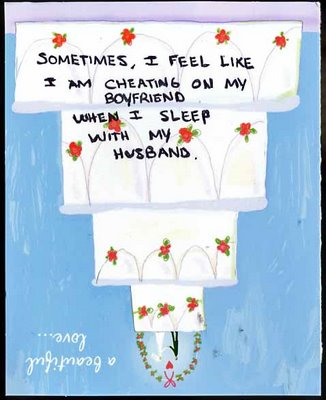
Women Cheat
Too
Should I Cheat?
Why Men and Women Cheat
How Men and Women
Differ
Flings vs. Long-Term
Affairs
Cheating While
Dating
To Confess or Not to
Confess?
Saving Your Relationship
Healing Exercises
Snippets
What
Do Infidelity Statistics Mean?
Polyamory
 21:30
21:30Rethinking infidelity ... a talk for anyone who has ever loved
It's tough to get a handle on how many of us are having affairs, given the inherent secrecy.
- 22 percent of married men have strayed at least once during their married lives.
- 14 percent of married women have had affairs at least once during their married lives.
- Younger people are more likely candidates; in fact, younger women are as likely as younger men to be unfaithful.
- 70 percent of married women and 54 percent of married men did not know of their spouses' extramarital activity.
- 5 percent of married men and 3 percent of married women reported having sex with someone other than their spouse in the year1997.
- 22 percent of men and 14 percent of women admitted to having sexual relations outside their marriage sometime in their past.
- 90 percent of Americans believe adultery is morally wrong.
- 50 percent of Americans say President Clinton's adultery makes his moral standard "about the same as the average married man,'' according to a Time-CNN poll.
- 61 percent of Americans thought adultery should not be a crime in the United states; 35 percent thought it should; 4 percent had no opinion.
- 17 percent of divorces in the United States are caused by infidelity.
- Source: Associated Press
- Up to 37% of men and 22% of women admit to having
affairs. Researchers think the vast majority of the
millions of people who visit chat rooms, have multiple
"special friends”. Dr. Bob Lanier, askbob.com

- Recent studies reveal that 45-55% of married women and 50-60% of married men engage in extramarital sex at some time or another during their relationship (Atwood & Schwartz, 2002 - Journal of Couple & Relationship Therapy)
- Only 46% of men believe that online affairs are adultery. DivorceMag
- 80% think it's Ok to talk with a stranger identified as the opposite sex. 75% thinks it's ok to visit an adult site.
- About 60 percent of men and 40 percent of women will have an affair at some point in some marriage "Monogamy Myth", Therapist Peggy Vaugn
- About 24 percent of men and 14 percent of women have had sex outside their marriages, according to a Dec. 21, 1998 report in USA Today on a national study by the University of California, San Francisco.
- Affairs affect one of every 2.7 couples, according to counselor Janis Abrahms Spring, author of After the Affair,as reported by the Washington Post on March 30, 1999. Ten percent of extramarital affairs last one day, 10 percent last more than one day but less than a month, 50 percent last more than a month but less than a year, but 40 percent last two or more years. Few extramarital affairs last more than four years.
- A lesser known fact is that those who divorce rarely marry the person with whom they are having the affair. For example, Dr. Jan Halper’s study of successful men (executives, entrepreneurs, professionals) found that very few men who have affairs divorce their wife and marry their lovers. Only 3 percent of the 4,100 successful men surveyed eventually married their lovers.
- Frank Pittman has found that the divorce rate among those who married their lovers was 75 percent. The reasons for the high divorce rate include: intervention of reality, guilt, expectations, a general distrust of marriage, and a distrust of the affairee.
- One-third of divorce litigation is caused by online affairs. This Is An Internet E-Mergency, The Fortino Group
- Approximately 70% of time on-line is spent in chat rooms or sending e-mail; of these interactions, the vast majority are romantic in nature. Dr. Michael Adamse, PhD., co-author of Affairs of the Net: The Cybershrinks' Guide to Online Relationships
- Because of the anonymity, affordability, and accessibility of Internet sexual resources, the computer can accelerate the transition from "at risk" to "addicted," as well as the progression of sex addiction in those with a history of prior sexual compulsivity. Cooper et al Survey
- 8-10 percent of Internet users become hooked on
cybersex. Dr. Bob Lanier, askbob.com
- Spouses who get hooked on Internet porn are a growing complaint among spouses filing for divorce, according to a survey of 350 divorce attorneys. "If there's dissatisfaction in the existing relationship, the Internet is an easy way for people to scratch the itch," said lawyer J. Lindsey Short, Jr., president of the American Academy of Matrimonial Lawyers, which conducted the study.
- 57% of people have used the Internet to flirt.
- 38% of people have engaged in explicit online sexual conversation and 50% of people have made phone contact with someone they chatted with online.
- Evidence proves there is a high correlation between on-line infidelity and subsequent real-time sexual affairs.
- Evidence supports the existence of disinhibition, accelerated intimacy, and hyper-sexual online behavior that can easily lead to real-time infidelity
- 31% of people have had an online conversation that has led to real-time sex.
- It is estimated that 53% of all people will have one or more affairs during their lifetime.
- Look at the numbers from Playboy Magazine:
- -2 out of 3 women and 3 out of 4 men admit they have sexual thoughts about co-workers.
- -86% of men and 81% of women admit they routinely flirt with the opposite sex.
- -75% of men and 65% of women admit to having sex with people they work with.
- The fact is that human beings are NOT monogamous by nature. That means they cheat.
- Experts say that a gut instinct is the most powerful indicator of a cheating lover. Adultery statistics state that 85% of woman who feel their lover is cheating are correct. 50% of men who feel their lover is cheating are right. The first clue is seldom obvious. Typically, it's a "feeling" that something is different.
- Cheating spouse statistics confirm that 50 and 70 percent of married men (between 38 and 53 million men) have cheated or will cheat on their wives. One study found that 2/3 of the wives (26 to 36 million women) whose husbands were cheating had no idea their husbands were having an affair - largely because they failed to recognize the telltale signs.
- According to Annette Lawson, author of Adultery, published in 1989 by Basic Books. "The various researchers arrive at a general consensus…suggesting that above one-quarter to about one-half of married women have at least one lover after they are married in any given marriage. Married men probably still stray more often than married women—perhaps from 50 percent to 65 percent by the age of forty." According to Maggie Scarf, author of Intimate Partners, first published in 1987 by Random House, re-issued in 1996 by Ballentine.
- "Most experts do consider the 'educated guess' that at the present time some 50 to 65 percent of husbands and 45 to 55 percent of wives become extramaritally involved by the age of 40 to be a relatively sound and reasonable one." According to Peggy Vaughan, author of The Monogamy Myth, first published in 1989 by Newmarket Press (third edition published 2003).
- Conservative infidelity statistics estimate that “60 percent of men and 40 percent of women will have an extramarital affair. These figures are even more significant when we consider the total number of marriages involved, since it's unlikely that all the men and women having affairs happen to be married to each other. If even half of the women having affairs (or 20 percent) are married to men not included in the 60 percent having affairs, then at least one partner will have an affair in approximately 80 percent of all marriages. With this many marriages affected, it's unreasonable to think affairs are due only to the failures and shortcomings of individual husbands or wives."
- In Hong Kong a woman is legally allowed to kill her cheating husband, only if she uses her bare hands. The husband's lover however may be killed in any manner desired.
Note that the above adultry statistics of the
prevalence of affairs were made more than a decade ago; so
based on changes in society during the intervening years,
the current percentage of the population who have had
affairs is probably somewhat HIGHER. For instance, the
continuing increase of women in the workplace and the
increase of women having affairs on the Internet means that
the numbers for women having affairs is probably similar to
those for men—about 60%.
Infidelity is one of the most wrenching experiences a couple can endure. It can destroy families, crush spirits, and break quite a few plates. It causes pain not just to the betrayed, but usually to the cheater as well.
So why do people do it? Experts say that the reasons fall
into two main categories. The first has to do with the
relationship -- there's either an emotional disconnect or
the couple's sex life isn't satisfying to one partner. The
second reason has nothing to do with the couple. Rather, one
partner simply wants the excitement of an affair, needs an
ego boost, or just feels entitled to have more than one
sexual partner. "Sometimes, you find someone who has a good
sexual relationship with his or her partner and yet has an
affair because sex is so important to them that they look
for it wherever they can," says Mira Kirshenbaum, PhD,
author of Too Good to Leave, Too Bad to Stay (Plume, 1997)
and The Emotional Energy Factor (Delacorte, 2003).
It's not uncommon for husbands or wives to suddenly find themselves in 'puppy love' with someone new. But before you take it from emotional to physical, consider this marriage expert's advice.
Most people think it will never happen to them: falling for someone outside of their marriage. The fact is, new flames (whether it’s just a crush or an infatuation) take many married men and women by surprise.
If someone new has your attention, it can be all too tempting to act on your impulses. But before you take that step into infidelity, ask yourself some key questions to help you answer the big one: “Should I cheat?” Your answers may encourage you to seek marriage counseling to resolve those emotional health issues that made this new person desirable to you in the first place.
Flirt with these ideas before you stray:
“Am I really falling in love?”
You said your vows and meant them, but here you are, falling for someone else. What’s next? Infidelity is not inevitable. “I would say that the person who is lured by romantic love needs to slow down, not make any rash decisions, and begin to appreciate the power of the chemistry of romantic love,” says Westport, Conn.-based marriage and family therapist Janis Abrahms Spring, PhD, author of After the Affair: Feelings of Pain and Rebuilding Trust When a Partner Has Been Unfaithful. “This other person may be a better partner for them, but often feelings of love can deceive as much as they inform.”
She advises being skeptical about the promise of this new love: Statistics argue against its survival. For example, while half of all first marriages fail, subsequent marriages are actually even more likely to fail.
“Should I tell my spouse?”
“There are advantages and disadvantages to revealing a secret like this — and people really need to review them for their own situation,” says Spring. Obviously, if you decide to leave the marriage, you will have to communicate why. But if all you have right now are some strong feelings for someone else, sharing them with your spouse at this stage could cause tremendous hurt and a possibly needless loss of trust. A more effective approach, says Spring, is for you to seek personal or marriage counseling to try to figure out what is driving your attraction and address any relationship issues that may have led you to this attraction.
“Should I stay or should I go?”
Before you venture into infidelity or dissolve your marriage, consider Spring’s conclusion after many years of working with couples dealing with affairs: “Another reason why those second marriages fail is because people take themselves with them,” she says. “They haven’t learned lessons from the first marriage so they take the same missteps into the second. They haven’t taken responsibility for how they poisoned the first marriage.”
Spring points out that there are certainly marriages that cannot continue, especially those that involve physical or verbal abuse or those in which one partner has an addiction for which he or she refuses to seek treatment. However, in situations where one spouse suddenly believes he or she has just met his or her soul mate in a new love interest and leaves the marriage for that person, that straying spouse may simply be avoiding accountability for his or her own failings as a partner.
“If I stay, can I still keep the new person in my life?”
If your answer to the “should I cheat?” question is a resounding no, then Spring counsels cutting off the source of your attraction completely. This means no personal contact, no letters, no emails — not even a “friend” status on Facebook.
“As long as you are e-mailing or chatting in some way with this person, they are going to drive a wedge between you and your partner,” she says. Despite your best intentions, the hard work of repairing your marriage will never be able to compete with the fantasy of that illicit relationship. Take a tough stand — this might even mean leaving a job or a department within your organization if the new attraction developed through work — and once you’ve cut that person out of your life, ask your spouse to go into therapy with you. “You don’t have to say you’ve fallen in love with someone else, but you can say you’ve started to have feelings for people and that that’s when you knew you were in trouble,” Spring says.
“Can I have a trial run with this new person?”
Taking a few weeks to get to know this new person is a very common temptation, says Spring. People fool themselves into thinking that they would be able to see the flaws in their “soul mate” with just a little one-on-one time. Not so, she says. “When people spend time with their lover, it’s like a honeymoon,” she explains. The reality of this other person probably won’t set in until well after a divorce is final, which, she says, is bound to happen if you take off for a while with your new love.
Your first priority is to be fair to your partner and yourself. Chances are, you have a partner who really wants to have a good marriage with you and who doesn’t know you’re as unhappy as you are, she says. “If you find yourself very enchanted with somebody else and are thinking of leaving, I would suggest hitting the pause button and trying to understand what your yearnings are all about.”
Remember, infidelity can have lasting ill effects and
should not be entered into lightly. You owe it to yourself
and your partner to first give marriage counseling a shot
— if not only to help you stay faithful, then at least
to understand what’s making you look elsewhere.
Source: www.everydayhealth.com/emotional-health/should-i-cheat.aspx?xid=aol_eh-emo_16-_20100516&aolcat=HLT&icid=main%7Chtmlws-main-n%7Cdl9%7Csec1_lnk3%7C213838
In general, men are more likely to cheat for more superficial reasons, like the need for excitement, while women are more likely to stray if there is serious trouble in the marriage. But those lines are blurring, says Nancy Glass, PhD, author of Not "Just Friends": Protect Your Relationship From Infidelity and Heal the Trauma of Betrayal (Free Press, 2002). "In the past, there were significant gender differences," says Glass. "The traditional male affair that was primarily sexual is changing because more men are having more emotional affairs (meaning their feelings for the "other woman" go beyond just sexual) with coworkers. Meanwhile, women are having more sexual affairs," says Glass. One reason: Women now feel more entitled to enjoy their sexuality, so if sex with their husband isn't satisfying they are more likely to look elsewhere than their mothers and grandmothers would have been.
Another trend: With more men and women working together side-by-side, as peers, there's an opportunity for deep emotional connections that didn't exist in previous generations. "You always had the boss who ran off with his secretary, but now I see many men who are in good marriages and are not traditional philanderers who form these deep friendships," she says. "They cross these lines and become more emotionally intimate than they are in their marriage. If there's some sexual attraction and chemistry, that's all you need for an affair."
Although affairs can and do happen to "good" marriages,
in general an affair is a signal that something is awry in
the relationship. "There are some cases when someone is just
having sex with different people out of a need for variety,
but most people really think before they go off in that
direction. If you have a good relationship, you're less
likely to jeopardize it," says Lonnie Barbach, PhD,
co-author with David Geisinger of Going the Distance:
Finding and Keeping Lifelong Love (Plume, 1993).
A one-night stand or a fling is significantly different from a long-term affair, says Kirshenbaum. "Many flings are essentially experimental. Someone finds something missing in their relationship and checks out what it's like to be with someone else. It turns out to be not-so-great, and they end it. Surprisingly, if no one finds out, often no harm is done. A long-time affair is a sign of a deeper rift -- it's more likely to be found out, and it's more likely to cause more damage to the relationship when it is found out."
We're stressing marriage here, but cheating also happens within unmarried relationships. Is it the same? "If there was no implicit promise of exclusivity, there's no violation," says Kirshenbaum. "But if dating is exclusive and there's a sense of moving toward a commitment, then it can be as big a betrayal as cheating during marriage."
The problem, of course, is that many unmarried couples don't ever sit down and declare a relationship exclusive, or not. And that omission can be the cause of serious pain. "Infidelity can have just as devastating an effect when one person thinks they are committed and one doesn't," says Barbach.
An affair in a dating relationship is also more likely to
be the beginning of the end. "Some people cheat as a way of
leaving a relationship. They set up the next relationship
before they leave the last," says Barbach. "That's different
from the person who cheats while maintaining the dating
relationship -- this person is much more likely to cheat
during marriage."
Which brings us to another point: Should you confess? In general, it's best to be honest, but our experts agree that there are circumstances when a spouse can spare his or her partner that information. "If a spouse has been suspicious and confronts him, he should confess," says Glass. "But if the spouse has no idea, and the betrayer takes responsibility for working it out on his own, he sometimes doesn't have to cause that kind of chaos," says Glass.
But once a confession is made, Glass says, absolute full
disclosure is essential, and the cheater should own up to
all affairs that have occurred during the relationship.
Can you rebuild trust after an affair? Absolutely, say our experts. Not only do most marriages survive an affair -- many come out stronger than ever. "I've seen many relationships that were much better after the affair, because up until then the couple wasn't dealing with their real issues. Dealing with the affair helped them communicate on a much deeper level," says Barbach.
"The affair is a symptom," says Bonnie Eaker Weil, PhD, author of Adultery: The Forgivable Sin (Hastings House, 1993) and Make Up, Don't Break Up (Adams, 2000). "But the good news is, it's a symptom you can fix. It's a wake-up call."
Building back trust is a long, slow process, but it can be done, says Kirschenbaum. "It's like carrying a bowling ball upstairs one step at a time. One slip and it rolls all the way to the bottom again."
Where to start: Stop playing the blame game. As difficult as this might be for the betrayed, he or she has to stop labeling her spouse as the bad guy. Instead, both partners need to understand what was going on for the other person. They should look at what precipitated the affair, and what each partner needs to do to make it different.
That's not to say that the cheater is off the hook. The cheater needs to do everything possible to make the other person feel safe -- whether that means handing over all credit card statements, providing cell phone and beeper numbers, or making frequent check-in phone calls. "The best thing that a cheating spouse can do is give his partner as much access as needed," says Glass.
The cheater must also be willing to discuss the situation as much as the betrayed spouse needs. Typically, the adulterer doesn't want to dwell on the incident, but the partner can think about little else. "For the betrayed partner it's so traumatic, and they frequently have flashbacks," says Glass. "So it's important for the unfaithful not to be impatient or think they are doing it to punish them."
Weil offers her clients some specific exercises for healing. In one, the betrayed spouse gets 10 minutes a day to "lash the lover" -- to scream and yell and otherwise vent his rage. This enables the betrayed to get out those ugly feelings, while the cheater knows there's a time limit -- which is essential. "If you lash out too much, it contaminates the relationship and brings the person back to the affair," says Weil.
To provide more security, she also instructs adulterers to say "I have had no contact" to their partner every day. This provides a clearly articulated answer to those vague fears that nag the wronged spouse.
Finally, Weil tells cheaters that they must do penance by taking on a chore that is normally not their responsibility, like washing the spouse's car or cooking dinner each night. "Penance should last for as long as the betrayed spouse needs," says Weil.
Of course, credit card statements and clean cars are only part of the equation. To really build trust, the betrayed needs to know that the partner definitely won't cheat again. But how to know? There's no guaranteed sign, but our experts agree that the overall pattern of the spouse's behavior is a good indicator. "The issue is, 'Am I married to a liar?,'" says Glass. "People who have affairs lie about them, but the majority of these people don't lie about other things."
Kirshenbaum agrees. In her 25 years as a couples therapist, she has discovered a reliable rule of thumb: "If someone cheats once, a couple can definitely recover if they both sincerely want to rebuild trust. More than once? It's a lost cause."
Most couples do recover -- and usually emerge closer than
ever. "Couples who learn how to work through it together
really have a special relationship because it's like going
to hell and back," says Glass. "This is a couple who know
each other on a very deep level, and that can make the
marriage very strong."
Source: Sara Eckel,
aol.lhj.com/lhj/story.jhtml?storyid=/templatedata/lhj/story/data/Cheating_03142003.xml
Opportunity makes the cheater.

 |
Menstuff® Directory
Menstuff® is a registered trademark of Gordon Clay
©1996-2023, Gordon Clay