
Menstuff® has compiled the following information on Teen
Depression.
 Crisis
Text Hotline 741741
Crisis
Text Hotline 741741
Want to
talk?
800.273.TALK (8255) or TDD
800.448.1833
Curry County Crisis Line - 877-519-9322
For other
Emergency
Numbers
International
Suicide Prevention Resource Directory
Substance Abuse Helpline
800.923.4357
Military Helpline 888.457.4838
Youthline for Teens 877.968.8491
What are the symptoms of
Depression?
What is Depression?
What to do if you are
depressed?
Where can I get more information about
Depression?
Study Shows 900,000 Teens Planned Suicides
While Depressed
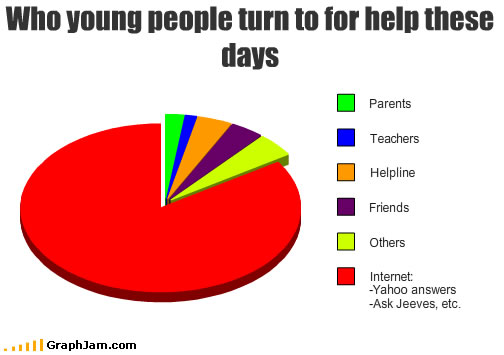
Who Young People Turn to for
Help
The Warning Signs and Major Risk Factors of
Teenage Suicide
Stigma
 5:06
5:06 
It's Gets Better
Study Shows 900,000 Teens Planned Suicides
While Depressed
What are the symptoms of Depression?
• Loss of energy and interest.
• Diminished ability to enjoy oneself.
• Decreased (or increased) sleeping or appetite.
• Difficulty in concentrating, indecisiveness, slowed or fuzzy thinking.
• Exaggerated feelings of sadness, hopelessness, or anxiety.
• Feelings of worthlessness.
• Recurring thoughts about death and suicide.
For more information: National Foundation for Depressive Illness
www.depression.org/symptoms.html
Think you might be suffering from depression? Try this online
quiz: depression-screening.org/screeningtest/screeningtest.htm
For more information: National Institute of Mental Health
www.nimh.nih.gov/publicat/depression.cfm#ptdep1
What to do if you are depressed?
• Set realistic goals in light of the depression and assume a reasonable amount of responsibility.
• Break large tasks into small ones, set some priorities, and do what you can as you can.
• Try to be with other people and to confide in someone; it is usually better than being alone and secretive.
• Participate in activities that may make you feel better.
• Mild exercise, going to a movie, a ball game, or participating in religious, social, or other activities may help.
• Expect your mood to improve gradually, not immediately. Feeling better takes time.
• It is advisable to postpone important decisions until the depression has lifted. Before deciding to make a significant transition-change jobs, get married or divorced-discuss it with others who know you well and have a more objective view of your situation.
• People rarely "snap out of" a depression. But they can feel a little better day-by-day.
• Remember, positive thinking will replace the negative thinking that is part of the depression and will disappear as your depression responds to treatment.
• Let your family and friends help you.
For more information: National Institute of Mental Health
www.nimh.nih.gov/publicat/depression.cfm#ptdep5
Where can I get more information about
Depression?
or nimhinfo@nih.gov
National Alliance for the Mentally Ill (NAMI), Colonial
Place Three , 2107 Wilson Blvd., Suite 300 , Arlington, VA 22201,
800.950NAMI (6264) or 703.524.7600 or www.nami.org
A support and advocacy organization of consumers, families, and
friends of people with severe mental illness-over 1,200 state and
local affiliates. Local affiliates often give guidance to finding
treatment.
Depression & Bipolar Support Alliance (DBSA), 730 N.
Franklin St., Suite #501, Chicago, IL 60610-7204, 312.988.1150, Fax:
.312.642.7243 or www.DBSAlliance.org
Purpose is to educate patients, families, and the public
concerning the nature of depressive illnesses. Maintains an extensive
catalog of helpful books.
National Foundation for Depressive Illness, P.O. Box 2257,
New York, NY 10116, 212.268.4260; 800.239.1265 or www.depression.org
A foundation that informs the public about depressive illness and
its treatability and promotes programs of research, education, and
treatment.
National Mental Health Association (NMHA), 2001 N.
Beauregard Street, 12th Floor, Alexandria, VA 22311, 800.969.6942 or
703.684.7722, TTY 800.443.5959, www.nmha.org
An association that works with 340 affiliates to promote mental health through advocacy, education, research, and services.
Source: www.facetheissue.com/depression.html
The Warning Signs
and Major Risk Factors of Teenage Suicide
Although it is almost impossible to predict precisely which teenager will attempt suicide, there are warning signs that parents can look for. The American Academy of Child and Adolescent Psychiatry has assembled this list of indications. If one or more of these signs occur, parents should talk to their teenager and seek professional help.
In high-risk patients—that is patients who have threatened or
attempted suicide—there are four risk factors that account for
more than 80% of the risk for suicide: major depression, bipolar
disorder, a lack of previous mental health treatment, and the
availability of firearms in the home. If these four problems were
solved, most suicides would be prevented.
© 2001 Maureen Empfield, M.D., and Nicholas
Bakalar. See also Teen
Suicide
Who Young People Turn
to for Help
"If you're feeling suicidal this would be an ideal time to try
what you always wanted to try but were afraid to try."

 |