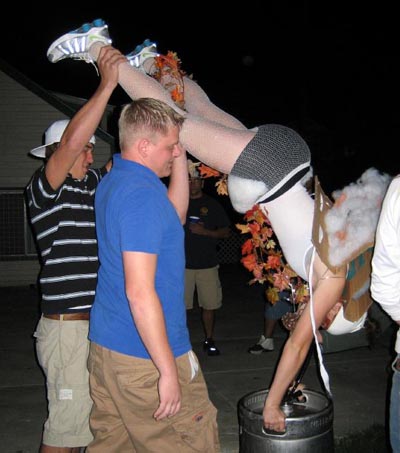
Menstuff® has compiled the following information on Binge Drinking. Click on picture above. It lends new meaning to the drinking term, "Bottoms Up!"
Want a referral to substance abuse treatment 24/7/365 call 1-800-662-HELP. It's run by the Substance Abuse and Mental Health Services Administration.


Click on this photo to see the potential after-effects of binge drinking.


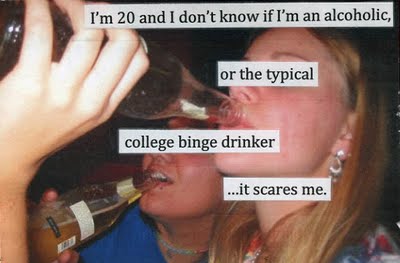
Definition
"How
Many Drinks Did They Have?" Blood Alcohol Content (BAC)
Estimator
Chart
Study claims binge-drinking on your
birthday can lead to dangerous
habits
'Drunkorexia'
prevalent among college students, study
finds
How
Healthcare Administrators Are Tackling the Binge Drinking
Epidemic
Don't
let your child go to one of these
colleges!
Are You
an Alcoholic?
Lowering
the Drinking Age
Colleges Use
Breath Tests to Curb Rowdy Behavior at Football
Games
Do
I have a Drug or Alcohol
Problem?
NIAAA Expert Urges
Community Action to Prevent and Reduce College Binge
Drinking
Getting
Drunk
Drunk
Girls on MySpace
A young woman
shared a shocking photo of herself to raise awareness about binge
drinking
Binge Drinking's
Swift Toll
Drunkeness
Triples College Kids' Auto Injury
Risk
A Kid's
Guide to the Effects of
Alcohol
Flip Flop
Flasks
Blood Alcohol
Concentration (BAC) Affect on Motor
Skills
It's
fun getting drunk!
Movie
'Beerfest' Celebrates Binge
Drinking
Immediate
License Suspensions for DUI Called
Effective
Driving Deaths
Peak in Summer, Parents Can Help Deter Poor Decision
making
Bad Jocks
Hazing
Alert: Binge
Drinking T-Shirts at Old Navy Stores
Realted Issues: Drinking,
Talk
to Your Kid
about Alcohol,
Teen
Alcohol, Teen
Drinking,
More
Drunk Girls
Book: Binge: Binge: What
your college student won't tell you. College life in an age of
disconnection and
excess.

A “binge” is a pattern of drinking alcohol that brings
blood alcohol concentration (BAC) to 0.08 gram-percent or above. For
a typical adult, this pattern corresponds to consuming 5 or more
drinks (male), or 4 or more drinks (female), in about 2 hours.
Source: www.collegedrinkingprevention.gov/1College_Bulletin-508_361C4E.pdf
Study
claims binge-drinking on your birthday can lead to dangerous
habits
The study followed 600 soon-to-be 21-year-olds who intended on celebrating their newfound legality by drinking. The researchers followed the subjects for a year and found that those who drank a lot on their birthday drank more heavily afterwards as well.
During the study's follow-up period, people who went all out on their birthdays drank 10 percent more than the typical participant on a night out. When compared to those who never drank before their birthday, the number rose to 17 percent.
In the U.S., if you have one glass of wine a night, you are in the top 30 percent of drinkers. Having two glasses every night puts you in the top 20 percent and 10 drinks per day, according to Stephen Cook's book "Paying The Tab," puts you in the top 10 percent.
So enjoy your birthday, but try not to go overboard. It could have
more consequences than that dreaded hangover the next morning.
Source: www.aol.com/article/lifestyle/2016/08/29/study-claims-binge-drinking-on-your-birthday-can-lead-to-dangero/21461388/
Binge Drinking T-Shirts at Old Navy
Stores
"As a non-profit organization dedicated to combating alcohol and drug abuse, Oregon Partnership was disappointed to find that Old Navy stores are selling holiday t-shirts promoting binge drinking.
"With Old Navy’s young customer base, the sale of such items are even more repugnant and not worthy of your company’s record in the area of social responsibility.
"T-shirts showing a Christmas tree and the words “Let’s Get Lit” or an elf drinking right from a keg send a message inconsistent with “bringing about social change” as spelled out on your website’s section on community investment.
"Underage drinking is a growing problem in our country. Massive amounts of advertising and promotion by beer companies and other alcohol manufacturers make it that much harder to reverse the trend and change the culture of underage drinking.
"But Oregon Partnership and other anti-drug coalitions are making real inroads in informing parents, educators, and the business community about how alcohol use among adolescents is even more dangerous to their developing brains than previously believed. And yes, we know that the culture can be changed. But we need your help.
"You might be interested to know that Macy’s and Bloomingdales decided to take beer t-shirts off their shelves a couple of years ago, which received substantial positive attention in the media. Other national chains have discontinued the sale of drinking games and other similar products.
"On a personal note, my kids love your Old Navy stores, but neither of their schools would ever allow them to wear your t-shirts with the alcohol messages.
"Thank you for your consideration, and hope you can join us in combating underage drinking and the promotion of products that encourage it.
Sincerely,
Pete Schulberg
Communications Director
Oregon Partnership
Source: opblog.wordpress.com/binge-drinking-t-shirts-at-old-navy-stores/
Blood Alcohol Concentration (BAC) Affect on
Motor Skills
Source: SpeedImpact.org
Movie 'Beerfest'
Celebrates Binge Drinking
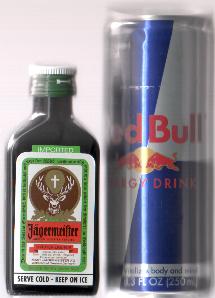
The Jager Bomb - Coming to a Neighborhood Near You
Winter Break saw a new mix. Bars were selling small buckets of
ice, a pint of liquor and a large energy drink like a 24 ounce
Monster. The students mix it all together, drink it down, and dance
all night.
Driving Deaths Peak in Summer, Parents Can Help Deter Poor
Decisionmaking
According to Liberty Mutual and SADD (Students Against Destructive Decisions) research, teens spend 44 percent more hours driving each week in the summer than during the school year. But the research gives parents a solution to keep their teens safe as young drivers exercise their summer freedoms behind the wheel: setting and enforcing consequences for breaking driving laws and family rules curbs speeding, piling in and cell phone use, and increases seat belt usage and adherence to traffic signals.
"It is refreshing to validate the influence parents have on their teen drivers and the fact that the tried and true measures we use to establish appropriate behavior in our children during their younger years – following through on consequences when expectations are not met – have the same powerful effect on teenagers," said SADD Chairman and Chief Executive Officer Stephen Wallace.
In a national study of more than 900 high school students with a driver's license, teens who believe their parents would follow through on threatened consequences for breaking a driving law are significantly less likely to say they speed (43 percent report driving 5 mph or more over the limit) than are the teens who say their parents are unlikely to follow through on any penalty (68 percent). Further, only 31 percent of teens who say their parents will enforce a consequence report they drive with more than three passengers in the car, compared to 60 percent of teens who consider their parents are "all talk and no action."
"These findings cannot be overstated. We all know that speeding contributes to crashes, and studies show the crash rate among teens drivers doubles or quadruples with two or three passengers, respectively, when compared to driving alone," said Greg Gordon, Liberty Mutual vice president, Consumer Marketing, citing research from the Insurance Institute for Highway Safety. "Parents can significantly reduce the likelihood of those behaviors by clearly establishing expectations of their teens and then following through on consequences should those expectations be breached."
Cell Phone Use and Text Messaging
As many states enact or consider legislation to curb cell phone use and text messaging while driving, the SADD/Liberty Mutual research further reveals how parents can influence the effects of these laws. More than half (52 percent) of teens who say their parents are unlikely to follow through on a consequence if they break a driving law report they talk on a cell phone while driving, compared to only 36 percent of teens who believe their parents would indeed penalize them.
And even in the absence of a cell phone law, the research confirms that parents can influence this behavior by establishing their own family rule about talking on the cell phone and driving – and enforcing it. Teens who say their parents are likely to enforce a punishment for breaking a family driving rule about cell phones are significantly less likely to talk on the cell phone while driving (37 percent) than are teens who say their parents are unlikely to follow through on any consequence (65 percent).
Applies to Safe Behaviors, Too
The SADD/Liberty Mutual driving research points out not only how parents can deter destructive driving behaviors by setting and following through on consequences, but also how parental enforcement bolsters safe driving habits. Teens whose parents enforce penalties for driving law infractions are more likely to wear their seat belts (89 percent vs. 74 percent), require their passengers to buckle up (82 percent vs. 64 percent), obey stop signs (91 percent vs. 60 percent), and use turn signals (89 percent vs. 76 percent).
Summer Driving Realities
Earlier SADD/Liberty Mutual research (2003) that reveals teens drive 44 percent more hours each week during the summer (23.6 hours) than during the school year (16.4 hours) also spotlights teens' admission to an increase in risky driving behaviors that contribute to crashes.
What Parents Can Do
Liberty Mutual and SADD use seven years of collective driving research to offer these tips to help parents talk to their teens:
Methodology
Liberty Mutual and SADD commissioned Guideline to conduct a quantitative survey with high school students on a wide range of attitudes and behaviors relevant to teens. An entire section of the survey was dedicated to teen driving. The driving report focuses exclusively on the responses of 903 teens with a driver's license from a national sample of 26 high schools in April and May, 2006.
The relevant, driving-specific findings can be interpreted at a 95
percent confidence interval with a +/- 3.3% error margin. Analysis of
survey subgroups are subject to wider error margins. Percentages in
the report may add to more or less than 100 percent due to rounding
error or occasions when multiple response answers were accepted.
Source: www.jointogether.org/news/yourturn/announcements/2007/reminder-from-sadd-driving.html
A young woman shared a shocking photo of
herself to raise awareness about binge drinking
Buzzed from having a couple of beers at the Night In The Country music festival, she decided to try to outdrink a group of friends who were drinking hard liquor. Lottritz does not remember the rest of the night, but friends tell her she chugged an entire solo cup of whiskey. She assured the group that she felt fine, but collapsed shortly afterward.
Her quick-thinking friends took her to the festival's medical tent, where she was intubated and airlifted to Renown Hospital in Reno, Nevada.
"I was in critical condition, suffering from acute respiratory failure and acute alcohol intoxication," she writes. "My blood alcohol concentration was .41 when I arrived at the hospital, five times over the legal limit. The doctors thought I was brain dead because I was completely unresponsive. My pupils were sluggishly reactive, I had no corneal reflex and I wasn't responding to verbal or painful stimuli."
She shared a chilling photo of herself taken just hours after being admitted to the hospital, showing just how dire her situation was.
Lottritz woke up 24 hours later, and medical staff told her that she was lucky to be alive.
"They told me that they didn't think I would make it through the night," she writes. "They asked me if I was trying to kill myself by drinking so much. This question hit me the hardest. From my hospital bed in the Intensive Care Unit, my eyes were opened to the seriousness of being irresponsible with alcohol. The next day when I was discharged from the hospital, I realized that the way I looked at alcohol would be changed forever."
In the blog post, Lottritz credits her friends for saving her life, and stresses the importance of drinking responsibly and looking out for others.
"I had good people around when all of this took place. I could have easily been taken advantage of when I passed out. I could've been left alone to 'sleep it off.' I can't tell you how many times I've heard the phrase, 'Let them sleep it off, they'll be fine in the morning,' but I'm alive today because my friends got me help. Don't take a chance if you see a friend passed out from drinking too much. Get them help as soon as possible. I'm very lucky to have made a full recovery, but I know there are others who won't be as lucky."
Bravo to Hanna for sharing her story.
Source: www.aol.com/article/2016/04/27/a-young-woman-shared-a-shocking-photo-of-herself-to-raise-awaren/21351972/
NIAAA Expert Urges
Community Action to Prevent and Reduce College Binge Drinking
Q. How much of a problem is binge drinking on college campuses?
A. According to the 2005 National Survey on Drug Use and Health, 45 percent of 18-24-year-olds who attended college said they consumed five or more drinks on at least one occasion in the past month. Studies consistently indicate that about 80 percent of college students drink alcohol and about 40 percent engage in binge drinking.
Q: Why should parents, the community and other stakeholders be concerned about this?
A. This level of heavy drinking among college students is associated with a host of other problems and people other than the drinkers themselves are being affected by this behavior. Our research indicates that an estimated 1,700 college students between the ages of 18 and 24 die each year from alcohol-related unintentional injuries, including motor vehicle crashes. In traffic deaths, about half are people other than the drivers. They are passengers and people from other vehicles. In addition to death, in 2001 there were nearly 600,000 college students unintentionally injured while under influence of alcohol; approximately 700,000 students are assaulted by other students who have been drinking and some 100,000 students are victims of alcohol-related date rape. Keep in mind that these figures don’t include 18 to 24-year-olds who are not in college.
Q: Is there a particular period of time when college students are most vulnerable to engaging in heavy drinking?
A. A student’s freshmen year, especially the first six to 12 weeks of school, is a time of greatest concern. For many students, it’s their first time not being under direct parental supervision. They’re entering an environment where there is a lot more drinking going on.
Q. Are there particular risks associated with drinking at an early age?
A. We know that the earlier people start to drink, the greater the likelihood that they will develop alcohol dependence more rapidly. So if we look at people who ever in their lifetime developed alcohol dependence, 47 percent were diagnosable by the time they were 21. Those who started drinking at a young age were more likely to have chronic dependence and less likely to seek help for their problem. Each year that people delay starting to drink, they lower their chances of developing alcohol dependence; of becoming unintentionally injured under the influence; of being involved in a physical fight due to drinking and of being in an alcohol-related motor vehicle crash.
Q. What can parents do to help their children make the right decisions once they get to college?
A. What parents can do begins when they’re children are in grade school and middle school. Parents can make a difference by communicating with their children, by teaching them resistance skills. Parents have a very important role to play, not just by providing one-on-one communication, but also by working collectively within their communities to address this issue.
Q. How important is the role of communities in reducing underage drinking and college drinking?
A. Colleges have a responsibility to address this problem, but they can’t do it alone because this is bigger than what happens in college. Prevention needs to begin long before they get into college.
Q. What are some steps community coalitions can take to curb underage drinking and college drinking?
A. There is a lot of evidence that comprehensive community interventions can help reduce drinking among college-aged persons, including students. One level is at the individual level, where one offers screening and counseling, particularly at trauma centers. Another level is environmental, where community coalitions can enforce the legal drinking age and a variety of other laws to reduce impaired driving. Comprehensive community interventions can intervene at all levels. Right now, there is tremendous concern among people in the community about college drinking so this is a perfect opportunity for community coalitions to bring another group of concerned citizens into their prevention efforts—that means involving the colleges and universities themselves, including faculty, college students and alumni, and parents.
Q. What are some resources that NIAAA has related to underage drinking and college drinking?
A. We have a “Back to College” Fact Sheet that can be useful for parents. Several other resources are available at www.collegedrinkingprevention.gov.
Source: Dr. Ralph Hingson is the Director of
Epidemiology and Prevention Research at the National Institute on
Alcohol Abuse and Alcoholism (NIAAA). This article is part of CADCA's
second editorial series featuring national experts from the NIAAA.
www.notmykid.org/Lists/Items/DispForm.aspx?ID=3032
Colleges Use Breath Tests to Curb Rowdy Behavior at Football Games
Under Minnesota's Check BAC program, student season-ticket holders who previously have been ejected from games for alcohol offenses must meet with a counselor and then submit to Breathalyzer tests to attend any future games. Students under age 21 must blow a 0.00 BAC to gain admission, while those over age 21 must be under the legal intoxication standard of 0.08 percent to be able to attend games.
No alcohol is sold insider TCF Bank Stadium, home of the Golden Gophers.
Past alcohol offenders who fail breath tests, or are found to have entered the stadium without taking a test, lose their season tickets.
The Minnesota program is based on Wisconsin's Show and Blow
initiative.
Source: www.jointogether.org/news/headlines/inthenews/2009/colleges-use-breath-tests-to.html
Booze is the answer. I don't remember the question.
Drinking too much makes a fool faster than it makes a man. -
Gordon Clay

 |